Another Little Peace of the Heart
An Excerpt from
By
Marc Barasch
He maketh wars to cease unto the end of the earth;
he breaketh the bow, and cutteth the spear in sunder;
he burneth the chariot in the fire.
--Psalm 46: 8-10
When I was in the third grade, my younger sister broke my favorite toy. I yelled at her, she screamed back, and then, to my surprise, she launched herself at me in a fury, scratching me hard on the arm. My reaction was blind, unthinking; I raked my own nails down her forearm, making furrows that, to my shock, began to ooze blood. I was punished, but nothing cut so deeply as the guilt I'd felt at her pain.
I've wondered from time to time what happened in this primitive, instinctual tit for tat, a variant of any playground fight. Some kid pinches you, and you pinch them back: There, now you know how it feels! The word revenge doesn't quite cover it; in an odd way, it's more like enforced empathy, a need to make the other feel, first-hand and in rough proportion, the suffering they caused us.
It's not such a leap from the dynamics of schoolyard rivalry to the logic of clan warfare: Here's what it felt like when you dishonored my family, terrified my child, killed my brother. Carried to its extreme, it is the twisted reasoning of warfare itself: This is what it is like to have your church destroyed, your crops burned, your city ruined. See how you like it.
On a typical day on the planet some fifty conflicts rage, from armed clashes of massed troops to guerilla skirmishes, civil uprisings, and border incursions, most of them classified as "low-intensity" (though scarcely so for the forty thousand whose lives they claim daily). The differences between sides--religious dogmas, nominal ethnicities--are often so tragically trivial, they only affirm the combatants' commonality. Even the most "just" wars seem heartbreakingly preventable had the victors in a previous conflict been kinder to the defeated, who rose up to become aggressors in the next. Despite their specifics, the basic narratives of territory, ideology, and historical grievance are so standard, all that's required is to fill in the blanks with the countries' names.
If we really want to heal our world, we'd better find an antidote beyond the topical remedies of truces and treaties. If war is an infection in the human system, its cure must lie in strengthening what it most directly attacks: compassion itself. If enmity draws a bayonet-sharp distinction between self and other, only empathy can cross that line (you in me, me in you). If strife builds up impenetrable armor (emotional; literal), then compassion calls for mutual vulnerability. If fighting is justified by some historic grudge, forgiveness destroys its rationale. If war is the repayment of blood debts, peacemaking assumes the infinite debt of love.
But how do we get there from here? We may all be in this together, but when I pick up the paper, I want to throw in the towel. Every official road to peace has a dotted white line running down the middle of it, like a perforation that says Just Tear Here.
Palestinians and Israelis are among the planet's unhappiest cousins, keeping the small house they cohabit in such constant uproar that it threatens to drag down the neighborhood. From an aerial view, the ancient sibling rivalry between the children of Sarah and the children of Hagar----Just get over it! No, you get over it!--looks like a pointless dustup in a sandbox. But it's also a tinderbox that could set the world afire.
Here every square inch of soil is claimed by great narratives both congruent and contentious. Here God is said to have been last seen face-to-face--the One whose angels broke bread in desert tents, whose only Son was crucified and rose, whose last Prophet ascended heavenward on a white stallion. Underfoot are ancient bones cubits deep, every step a genuflection to the past. The living feel upon them the watchful eyes of ancestors whose begats go back to the Beginning of It All. Would that the Holy Land were not just hallowed ground, but a seedbed for the peace that passeth understanding.
That isn't the latest bulletin from Bethlehem, but there is news behind the news, and it comes down to this: three teenage girls sitting, knees nearly touching, their ancient enmity for now foresworn, trying to make a little peace of the heart. Amal, an eighteen-year-old West Bank fundamentalist with streaked blonde hair is telling an Israeli girl that Muhammad was the last Prophet and the Koran the final Book.
"God gave us all the land. He orders us into jihad--not just war, but holy war."
Rachel, a fair-skinned Israeli girl in blue jeans, flushes deeply. "By Jewish law, all Israel is for the Jews. By Muslim law, it's all for the Arabs. The only way possible to fulfill these laws is by killing millions of people!"
Fatima, a dark, curly-haired Palestinian born in Israel, is caught in between. "I feel lost. I'm half-half. I can imagine the little child who saw her daddy shot by soldiers in Jenin and the Israeli kid whose mommy was blown up on a bus. My father was killed. Everyone I know has lost their cousins. I'm sick of these mean leaders who only want their place in history. Stop hurting each other, that's all I can think of."
The three are part of a group of some thirty girls* flown from an eternal war zone to a borrowed lakeside estate deep in the heart of rural New Jersey. Under the auspices of a program called Building Bridges for Peace (part of a larger organization called Seeking Common Ground), they will live together for two weeks, sleeping in one big room on air mattresses, their relationships a microcosm of internecine strife and a litmus for any hope of resolving it.
"I feel like I live in the middle of a stupid world," Rachel tells Amal and Fatima. "All that's important to me is you, and you. We're destined to live together in the same place at the end of the day. If I don't know you, it's easy to hate you. If I look in your eyes, I can't."
Amal shrugs elaborately. "When we're here, who knows, maybe we're friends. When we return, you are my enemy again. My heart is filled with hatred for Jews." She says it bluntly, coolly, planting her flag. But I detect a wistfulness, the barest hope that her burden--of poisonous rancor, of history's dolorous weight--might somehow be lifted from her shoulders.
"History," wrote James Joyce, "is a nightmare from which I am trying to awake." This is no high school civics debate, and Rachel's "stupid world" is no typical teenage plaint. There are Israelis here who one day soon will be girl soldiers carrying rifles that could be pointed at Amal--at sad Amal, whose uncle was arrested, released, and soon after shot dead in his home by soldiers; haunted Amal, who will never forget; vengeful Amal, who admires the shaheed, the suicide bombers; hard-hearted Amal, who has come here a hater but may secretly hope she can learn how to love.
A child of the second intifada, Amal has never met Jews who don't wear fatigues and combat boots. "She's one of the generation that 'did not know Joseph,'" says Melodye Feldman, the preternaturally calm American social worker who founded the programs. Melodye grew up as one of only three Jews in her Florida grade school. She remembers one of her friends groping the top of her head to feel for horns; remembers being jumped, kicked, thrown into puddles, coming home to her parents and sobbing, "If only they knew me, they would like me."
It could be the motto of her program. She has been bringing together Israeli and Palestinian teenagers for the past ten years with no other agenda than to place them in fertile soil for compassion, give them water and sunlight, and hope they grow. Melodye, who was an Orthodox Jew and staunch anti-Palestinian until visiting East Jerusalem in 1989, was inspired to act after seeing firsthand the mounting despair among the youth of both sides. Meeting sometimes in secret with Palestinian counterparts, she proposed a program whose only goal was to shatter the stereotypes of the Enemy. "I didn't know what I was doing," she admits freely. "I just wanted to do something to give young people some hope." She designed a camp-style retreat for young women that would use every tool of empathy she could borrow or improvise. What resulted is a sort of living lab for peacemaking, its protocols honed through trial and error.
At the first Building Bridges program some girls, in close quarters with their adversaries for the first time in their lives, were desperate to leave, but Melodye had shrewdly confiscated their tickets and passports. "You're not your nationality here," she told them. "You're not your ideology, your religion, your history. All that counts is who you are as a person." The Palestinians staged a demonstration, refusing to share tents with the Israelis. But then a freak storm blew in, full of Old Testament thunder and Koranic lightning. "They all got in tents together fast," says Melodye, "and snuggled up during the night."
The next morning, one Palestinian girl confided how soldiers had come to her home, beat her family, and upon discovering they were mistaken, left without apology or offer of medical care. Using a technique known as "compassionate listening," Melodye asked a Jewish girl to repeat the story in the first person, then describe the emotions it had made her feel--terror, anger, revenge, sadness. The Palestinian girl burst into tears. "My enemy heard me!" The Israeli girl wept with her, and they became fast friends. Melodye, a cheerful, unflappable forty-five-year-old whose sharp eyes, set in a soft, open face, convey the impression little escapes her, knew she was onto something. "As the saying goes, God gave us two ears and one mouth," she says, and so she created a program devoted to listening.
There hasn't been much listening in the Middle East. Even if the two sides were so inclined, the shouted slogans, crackle of small-arms fire, explosion of bombs, and grinding of tank treads muffles the dialogue. These are children of war, Melodye says. They've known little but stress and trauma, life in a garrison state, an occupied town, a refugee camp. Many have never met anyone from the opposing side. They are dispatched to her program by their respective communities, thinking they will champion their cause to the enemy's face.
Instead, they wind up literally taking their enemy's pulse: The first thing Melodye has them do is gently grasp each other's wrists. "They've never touched their 'enemy'; they have no idea what they feel like. Then suddenly it's like, 'Oh, warm! I feel blood beating!'"
A few of the kids have been to other programs--"youth diplomatic corps," one put it a little sarcastically--the kind where issues are debated and coexistence extolled. But Melodye doesn't want them to coexist; she wants them to care about each other. She's insistent on keeping it personal. Keep your hate, if you must," she tells them, "but now just touch her hand, her face, look in her eyes, speak your heart. These kids have yet to pick up weapons, but their minds are locked and loaded, ready to go off half-cocked. "Here, you just give those stares that could kill," Melodye tells them. "When you get back, you could do much worse. This could be your last chance to know the other side, their hopes, their dreams, what they're really feeling."
Melodye will try anything to get them to drop their canned historical laments and encounter each other as people. They make life masks out of plaster, molding the wet goop over each other's faces, tracing the unknown contours. She gets them to form a soft machine by connecting to each other with motions and sounds, or sit in a circle singing nonsense songs, patting their own legs and those of their neighbors in a blur of rhythm. They're from a part of the world where symbols count, and the games are rich with metaphor: At their first meeting, staff members, mostly Palestinian and Israeli kids who've been through the program, loop rope "handcuffs" around the girls' wrists, entangling them in binational pairs, challenging them to get free of each other when tugging on one end only pulls the other end tighter.
I chat with a Palestinian girl wearing a T-shirt with a cartoon gun shooting a little flag that says bang. Kids on both sides talk of violence with stunning casualness. "I had all these boys who wanted to marry me," she tells me. "One said if I didn't, he would bomb himself." I'm shocked, but she just giggles: Threatening to strap on a suicide jacket is a common boast of lovesick West Bank suitors. Her fiance is with the Palestinian intelligence service; his job is to ferret out the ameel, the collaborators--find them, report them, maybe hurt them. For her, the intifada is always and everywhere; for the Israelis, it's wondering about the next bus bomb, worrying if, as citizen-soldiers, they'll be sent across the green line into the occupied territories.
But at this camp there are no dividing lines but the ones the girls bring with them and carry inside. I eavesdrop as they talk their teenage flotsam and jetsam of shoe styles and skin care, boys and CDs; girls who on both sides are every hue from freckled white to dark olive, who by their ancient genome are virtual half sisters. I find it hard to comprehend how deeply Other they are to each other.
"An enemy," wrote psychologist Karen Horney, "is an economical way to form an identity." Economical, but surely not cheap, with its costs amortized in collective tragedy. The Israelis are raised hearing about the horrors of the Holocaust and their state's David-and-Goliath victories over Arab foes bent on their annihilation. "We're shown the old family photos and it's 'Hitler got her, Hitler got him,'" Rachel tells me. "Every year on Holocaust Day, survivors lecture in the classrooms. One history final exam is mostly about the Holocaust. And then we all join the army."
The Palestinians grow up hearing about the Nakba, the Catastrophe of 1948, when according to dueling versions of history, they fled or were driven from their hereditary lands as Arab armies marched into battle against the Zionist Jews creating a nation in their midst. In the wake of utter defeat, living as refugees for generations, a stateless people in their own diaspora, they have taken guerilla commandos and suicide bombers for heroic role models.
"After fifty years of occupation, chaos, and resistance," sighs one of the Palestinian staffers, "we're all fucked up. To live as a refugee, it's the same as being subhuman. We're going to need years of national therapy. The whole Middle East needs therapy!"
Therapists have taken a keen interest in the conflict as a case study in how war and hatred take root in the human psyche and how they might be extirpated. Each side in the conflict, says Israeli psychiatrist Yitzhak Mendelsohn, sees itself as a victim of history struggling to survive in a hostile world, with the other side as the ultimate threat to its existence. Individual biography is woven into a collective narrative of woundedness--what he calls a "dependence on negative memory. People get hooked into a potent resentment that primes them for revenge and escalation. Hate becomes a way to create the illusion of power."
Mendelsohn, a quick, intense man with a neat black goatee, comes to his specialty in "ethnic national conflicts" from an intimate perspective: Grievously wounded in a Palestinian terrorist attack on a restaurant ("I got two bullets and needed twenty-five units of blood"), he is a self-described "victim without hatred." He is, he says quietly, "personally familiar with the psychological obstacles to peace." The task of reconciliation, he believes, is to break down the "symbolic scars that bind people to the group" and offer "some larger sense of 'we' to replace the victim identity."
Melodye has her own diagnosis. "Nations are stuck in a developmental phase approximating an adolescent identity crisis," she says, "refusing to compromise, seeing everything in black and white." It's hard to argue the point: geopolitics as teenage wasteland. An adult personality can selflessly give, but the world's nationalities are grabby, cliquish, defensive, obsessed with ego-boundaries. They announce, "It's my room and I can do what I want in it," leaving a mess for others to pick up after them. They gang up on weaker kids; they're hypersensitive; they lash out explosively. There is a line in the Chatu-Shataha Shastra: "Buddhas see delusion as the enemy / And not the childish who possess it." How many posturing politicians and gung-ho generals have the courage of these coltish girls who struggle to see through delusion to reality's shades of gray--and beyond, to life's true colors?
These kids who could soon be gazing down gun barrels at each other are just teenage girls with half-articulated thoughts and inchoate longings, still safety-pinning their identities to fit: One minute they're mouthing the slogans of the intifada or proclaiming the tenets of Zionism; the next they're tooling around on the pink Schwinn they found in the garage or teaching each other American country-swing steps.
"First they need to define the box they've placed themselves in," Melodye says, "then they can step outside it." In an early session, they're asked to list, in order, their most defining characteristics. A Jewish girl says, "Family, friends, music, Jewish religion"; another says, "Being from the city, being a high school student, clothes, travel." Other Jewish kids put "human being" first, or the environment, or love of animals. But for most of the Palestinians, the list is more circumscribed: Arab, Palestinian, Muslim, colonized, refugee. It is the template of oppression, of a people defying erasure by carving a collective face in granite. If each side is living in an identity-jail, the Israelis' is medium security, the Palestinians' more like twenty-three-hour lockdown.
"Self-esteem is in large measure a function of the esteem accorded to groups of which one is a member," writes one social psychologist. As a result, he notes, "The sources of ethnic conflict reside, above all, in the struggle for relative group worth." It reminds me of a T-shirt I saw on a marcher in one of New York's ethnic parades: "It ain't where you at, it's where you from." (No, I wanted to say. It is where you at. And here is a recipe for peace: 1) Cut pride into bite-sized pieces; 2) chew; 3) swallow.)
This is not to argue against ethnicity, which is in any case a fact on the ground. In a homogenizing global society, with the unique wisdom of entire cultures being lost as surely as languages themselves are going extinct almost weekly, we need a counterweight against punch-card citizenship in a corporate McWorld. But without the translucent overlay of a common human identity, real peace is a mirage on the horizon.
"We're all of us brainwashed," Fatima, the Israeli-Palestinian, says to the circle. "We accuse each other with these phrases, but don't know what they mean. We want freedom? What is it? Words someone told you to say, not really coming from your heart. Seriously, where did you get all that stuff?"
"What do you think causes war?" Melodye asks them.
"History," says one.
"Injustice," says an Arab girl in a headscarf.
"Religion . . . leaders . . . misunderstanding," offer others.
"We do," says Fatima. There's a silence as it sinks in. "All of us. Without people buying into it, it wouldn't happen."
As the days go on, identities become more fluid. One minute they are pouring salt into each other's wounds, the next probing them as tenderly as private-duty nurses. They talk it through, feel it through, first in anguish, then in relief: "I don't want to kill you." "Well, I don't want to kill you, either!" I hear ululation drifting in from the sunporch used by the Palestinian delegation, the yearning, keening vocals of Arab pop music mingling with sinuous Israeli rock from the dining room.
They're having a great time, but this isn't just Camp Kumbaya, telling stories by the campfire, singing and eating s'mores. Their ability to resolve their blood feud is a field test for peace on earth. If these girls can't find a way to love each other, what then? I find myself walking around with a lump in my throat, thinking how it has fallen to them to do what their foolish leaders will not.
One day, paper bags labeled with the toughest hot-button issues are put in the center of the room, and each girl is asked to write down a phrase that best expresses her feelings about it. The responses are scrawled in magic marker on big white pieces of paper and posted on the walls.
Under "Zionism," an Israeli has written, "idealists who fought to come back to their country," and a Palestinian, "an evil organization that wants to kill all the Arabs in the world."
Under "Palestine," a Palestinian has written, "a dream that will come true, my homeland forever, my soul," and an Israeli has scrawled, "hostile territory, a danger for my existence."
Under "suicide bomber," the Israelis write "a killer" and "a dead murderer"; and the Palestinians, "a blessed person," "a winner in the next world," and, chillingly, "what I hope to be."
The kids shuffle from poster to poster, subdued, disbelieving. Now it's all been shoved out into the open, every threat and calumny; their faces are ashen at this secret ballot of fear. I can hear everyone's heart thud in the silence; it's suddenly a roomful of hunted rabbits.
"I see these words and I feel scared and angry and want to leave," says one Israeli girl.
Tears tremble on eyelashes, overspilling rims of reddening eyes as they attempt to smile through the pain, as if to spare others, or cling to their sinking hopes. A passed Kleenex box quickly empties.
"It hurts so much that each of us has deep hatred for the other. It's like you've been sleeping in the same room with a person who wants to get rid of you." My notes don't say whether this was spoken by a Palestinian or an Israeli; it's irrelevant.
The dire mood is fleetingly broken by the town's Funny Bunny Ice Cream truck careening around the corner outside, blaring its tinny recording of the Disney anthem, "It's a Small World After All." A few kids who recognize it laugh at the irony.
As the tears dry, they're more curt, defended; they put on their game faces. "I feel proud to be Arab, proud to write these words about jihad and shaheed," says Amal defiantly. They trot out their litanies of grievance, their sullen prejudices. But they also seem to recognize something momentous is occurring. For once in their young lives, the truth has been laid bare, a force to be reckoned with--unpredictable, frightening, liberating. "These words on paper are our biggest fears," says Fatima. "They're what we're hiding behind our laughing faces, being dishonest one to the other. I want to learn about them from you."
Later, they are asked to build a bridge out of arts and crafts supplies. As they sort through Popsicle sticks and pipe cleaners, Rachel and Fatima tell Amal, "We're here to listen to anything you want to say." But Amal shakes her head. She doesn't want to talk. "I just want to draw a bridge," she says tersely. "A bridge that's been broken."
It sometimes seems the bridge has been broken since time began. What are the root causes of war, of millennia of hatred and strife? Those who study conflict look at everything from politics and economics, history and religion, child-rearing methods and marriage customs. But some point to a key human (and for that matter, primate) emotion that, in individuals and nations alike, seems to drive the cycles of violence: humiliation. "People would often rather die than live with such a sense of shame," writes one psychologist. "Even considerations of self-interest become irrelevant." The need for recognition, to be heard and seen, is universal. The Nazis cunningly appealed to restoring German pride after the crushing settlement imposed by the victors of World War I. In 2001, a nameless man--was it in the streets of Cairo, Karachi, Jakarta, Damascus?--cried out from among a crowd that cheered 9/11: "You Americans think we are nobody, like you are the only human beings," he said. "Now you have heard us. Now you know we, too, are men!"
Shame is a wound to the very sense of self. Palestinians speak of the daily humiliations of border crossings ("We're herded into a chute like cattle," one girl tells me bitterly), of grinding poverty and strutting Occupation soldiers. One girl tells me how her father died in an ambulance held up for four hours at an Israeli checkpoint outside Jenin even as his heart gave out. He was forty-seven. "I had thoughts about becoming a bomber," she says. "But I realized when I came to this camp last year that there was nothing worse than to lose my life to make others die. The responsibility for this suffering, it's not Jew or Arab; it's this circle of history, of violence with no beginning or end."
Humiliation is surely not just the province of the Arabs. "For Jews in general and Israelis in particular," says a writer in the Jewish magazine Tikkun, "there is a lasting form of shame associated with having been vulnerable and victimized during the Holocaust . . . a determination 'never again' to be subject to such humiliation as to be helpless prey to a ruthless predator."
The Holocaust Museum is a marble building like others in the nation's capital, a massive stone cube devoid of postmodernist histrionics, built to last for as long as history shall endure. As I walk through the entrance, passing a sculpture of a deconstructed black swastika, its arms twisting to the sky, I see a quote by President Jimmy Carter carved into the wall: "We must harness the outrage of our memories to stamp out oppression . . ." In the company of the Palestinian and Israeli girls, bussed down for an all-day field trip, it strikes me as a very Middle Eastern sentiment: Isn't this what the Palestinian shaheeds think they are doing? And the far right-wing Israeli settlers? All over the world, there is no problem harnessing outrage; the problem is keeping hold of the reins.
A museum guide highlights the exhibits she feels are "pretty neat--check them out"; the atrium, she suggests, is "a fabulous place to take pictures." But the museum is not designed as a tourist attraction. It is a funnel into moral blackness. To walk its corridors is to follow the saga of a civilization's premeditated murder of compassion itself. First the Nazi book-burnings, harbingers that failed to kindle the world's alarm. Then the artificial creation of stark ethnic divisions: here the lurid charts of racial mug-shots; there a poster promulgating laws against "racial defilement" and a glass case full of "scientific" meters of curious design: calipers to measure skulls, and eye- and hair-selection guides in handheld compacts for white-gowned nurses to classify children for extinction.
The visitor's claustrophobia grows as exhibits show all cultural institutions--art, music, theater, medicine--suborned in service of the deranged hygiene of ethnocentrism. In his 1906 book Folkways, W. G. Sumner catalogued the ubiquity of the self-versus-other distinctions made by tribal cultures the world over. "Each group nourishes its own pride and vanity, boasts itself superior, exalts its own divinities, and looks with contempt on outsiders."* There are only a few insidious steps to regarding the other as subhuman; astonishing, unthinkable, but to anthropologists, sickeningly familiar. Sumner notes in a later work that nearly all the tribes he had studied called themselves by names that meant simply "'men,' 'the only men,' or 'men of men'; that is, 'We are men, the rest are something else' . . ." Modern anthropologists point to the Amazonian Yanomamo, whose fierceness seems to derive in part "from their belief that they were the first, finest and most refined form of man to inhabit the earth, and that all other peoples are a degeneration from their pure stock." Among the headhunting Amazonian Mundurucu, rival tribes were linguistically lumped with game animals, providing a conceptual frame to overcome the natural aversion humans have, along with all other creatures, to methodically killing their own kind.
The Holocaust Museum corridors narrow as Hitler's power grows and the tapes of crowds Sieg Heiling themselves hoarse grow louder, engulfing the visitor in a gathering dark. The museum's architects have designed passages that dead-end in cul-de-sacs, emplaced red-and-white-striped barricades. You don't know where you're going until you get there, and even then, you're not sure you haven't been treading a no-exit circle. One exhibit tells the saga of the Lodz ghetto, sealed in April 1940, trapping 164,000 Jews behind bricks and barbed wire, forcing them to live with "overcrowding, starvation, disease, and the stench of raw sewage," the first of four hundred ghettos created to wall off the millions.
From there, you traverse a wooden catwalk and embark on a journey into Hades: a railcar with a thin shaft of light falling onto a blood-red wooden floor. Pathetic piles of abandoned luggage, hand mirrors, hairbrushes, and toothbrushes. The malignant efficiencies of industrialized murder: canisters of Zyklon-B; a narrow bunk from one of the Auschwitz barracks where skeletal prisoners lay awaiting the fire. Relics of Dr. Joseph Mengele's infamous Block 10, where the most gruesome medical experiments were performed; photos of sterilized children, of bodies disassembled like department-store manikins. A line from Elie Wiesel: "Never shall I forget the little faces of the children whose bodies I saw turned into wreaths of smoke beneath a silent blue sky . . ."
I see one girl who'd proclaimed herself a would-be jihadi in tears. An Israeli, overcome, sags against the shoulder of a Palestinian friend, who clasps her tight. I see others walking slowly, arms around each other's waists.
When the dark corridors open out at last into the muted, sifting sunlight of the white marble Hall of Remembrance, I finally break down and weep. When I emerge, I see Amal and two of the more militant Palestinian girls in checked kaffiyeh photographing each other as they sign the visitors' book in Arabic. I feel touched.
Yet there is something odd as they mug for the camera, flashing their V-signs. A whisper goes through the bus on the ride home, building to an agitated buzz. An Israeli who reads Arabic says the girls wrote something terrible, something unthinkable. What they had inscribed, in large, curlicuing letters, was: "Death to All Jews."
By the time they get back to camp, all the girls are in an uproar. They gather in knots to scream and to cry, beside themselves.
"It's none of your business what I write!" shouts Amal. She claims it's freedom of speech. "The guard told me to write what I felt, and this is what I feel. If Jews went through all this suffering, why do they make us suffer, too? I've suffered. I get to say it."
"So now it's public!" a Jewish girl yells back. "It proves you want to hurt us, to exterminate us! I can't believe I spend a week with you, and now I know you want me dead."
"Don't you feel sad at the piles of bodies, the millions who died?" another Israeli demands, in tears. "For a few hours, you couldn't just leave off your suffering and feel ours?"
But this is just the point. A quiet, lissome Palestinian who has barely spoken all week shouts: "We've seen bodies, too! What do you expect? We go through hell because of you. A ninety-year-old Holocaust survivor at least has had some happiness now, for himself, for his children. I don't know how much longer I can go on. One day when I'm sick and tired of all this, I might blow myself up!"
A shocked gasp goes through the room. It takes me by surprise, too, though it shouldn't have: Many Palestinians saw in the museum not the sorrowful history of the Jews, but a mirror of their own plight. They did not, could not empathize; the pain of the other only reminded them of their own.
"Ghettos, checkpoints, identity cards, this is my reality back home," one told me. "A camp with barbed wire, surrounded by soldiers, the streets filled with sewage. My dad grew up in a refugee camp, and then me. I saw me in that museum--me every day, not fifty years ago. I can't compare it to medical experiments and extermination. But I felt defensive: This is happening to us, too."
Amal will bend only this far: "I should have written death to all Israelis, not death to all Jews." One of the Israelis spits out, "You expect to be treated as a human being, but you don't act like one. You don't deserve human rights!"
Amal's eyes go hard and glossy, her face immobile as a basilisk. The lowest blow, for them, for anyone, has been struck. "It's the Israeli soldiers," she says, her voice finally breaking a little, "who shout at you, 'You don't deserve to be treated as human.'"
Shoah. Nakba. My people's historical disaster is more horrible than yours; its wounds fresher, its losses more enduring, its anguish more palpable, its injustice a sharper blade. But is there no end to it, each tragedy planting the seeds of the next? The Serbs who oppressed the Muslims in the ethnic cleansing of the late 1990s felt they had been oppressed by the Muslim Ottoman Turks, the injury of their defeat still throbbing after six hundred years. The unhealed wound is the psychoanalytic nubbin of the problem; everything else, the fighting and the oppression, can seem like mostly acting out. The whole planet wired with big red sticks of dynamite like an old Warner Brothers cartoon, the close-packed explosive of unassuaged anguish, a fuse waiting for the right matchstick of a hatred only kindness can snuff out.
"If we could read the secret history of our enemies," wrote Henry Wadsworth Longfellow, "we should see sorrow and suffering enough to disarm all hostility." But in many places around the world, this equation is forbidden to have an equals sign. "The Jewish community would be up in arms," says Melodye, if someone dared to compare one people's ultimate tragedy of genocide with another's of exile and oppression. "They would be called a self-hating Jew, anti-Israel."
In May 2004, Israel's justice minister, himself a Hungarian-born Holocaust survivor, criticized a plan to demolish Palestinian homes in Gaza. As quoted in a New York Times story headlined "Offering Empathy," he told Israeli radio: "I did think, when I saw a picture on the TV of an old woman on all fours in the ruins of her home looking under some floor tiles for her medicines--I did think, 'What would I say if it were my grandmother?'" His remarks created a wave of national outrage. Scolded a fellow cabinet minister: "Any analogy, even hinted at . . . has no place in any form."
Primo Levi writes with grim eloquence in The Drowned and the Saved of the pain seared into collective memory: "The injury cannot be healed; it extends through time, and the Furies, in whose existence we are forced to believe . . . deny peace to the tormented." But it must be healed, lest the injury be transmitted down through generations, forever blighting new lives. There is hardly time to wait for national policies and official proclamations. What's needed are private edicts of empathy, little peaces of the heart. The work couldn't be harder, or more humbling: the hearing and telling of the world's most painful stories; the emotional truths that are too hot to handle alone.
I watch as Rachel and Amal attempt to mirror each other's feelings in front of the group, trying to neutralize even a scintilla of the elemental toxin. Their body language says it all. Arms folded, legs crossed, heads turned to the side, barely glancing at each other, they are stoic, removed, their looks searing. They repeat each other's words with smirks and rolling eyes. They interject their own opinions, Rachel taking a moral position, citing history and ethics; Amal an emotional one, claiming the Jews are blind to the suffering under their noses.
It seems as if there can be no meeting ground, for nobody's pain is dispensable, not even for a second. The conversation advances a few notches--"We need to point to the tragedy for humanity," a Palestinian suggests--but I notice something happening that is beyond words. Even in the midst of their outrage, the kids, Israeli and Palestinian alike, are treating Amal not with ostracism, but with an outpouring of affection. She had done her worst, walked up and detonated her nail-bomb of hate-speech in a supreme shrine to memory, and yet they refuse not to love her. She pretends not to notice at first, or to care, but when Rachel, leading a game, asks Amal to come play, I see a quick flash of relief. She hesitates only a moment before joining in.
The next day has been scheduled on the calendar as a day of silence. Before it officially begins, Rachel approaches Amal, who today wears a black T-shirt spelling Mustard in jagged yellow letters. "Look, I know I will never fully understand your pain," she says awkwardly, her tone struggling against formality, "but I'm sorry for what happened to you in your life. I might seem only angry at you, but I was hurt, too. I know you wrote those words because you thought no one knew your suffering." Amal, gazing into the middle distance, finally nods with the smallest of smiles. Rachel tells me later: "All that day, we communicated with looks and hands. And when I could turn to her with words, we were talking again about this and that."
Rachel later wrote a short story that is, for an Israeli, a traitorous heresy, comparing the Hebrew concept of milhemet hakodes, the holy struggle to preserve one's humanity against all that seeks to erase it, with the "holy war" of jihad. Could these vile acts, she wondered, stem from the same desperate drive of a people to assert a sense of self-worth?
"People call me a moral relativist for seeing both sides," says Melodye. "They pat me on the head and say I'm naive for thinking I can make peace this way. But I know that even the smallest steps are good. I tell them it's messy work here on the ground, but one by one, people really do change; and those who do, change others. It may take generations, but real peace will come."
In small ways, it already has. One of the Palestinian staff, Muna, confides to me, "I used to completely deny the Jews' suffering. Then I became close to an Israeli and realized, all this horror happened just fifty years ago. Their parents are orphans. They're all in recovery." Her sense of empathy had come to her unexpectedly. Muna's brother is still, after years, in Israeli administrative detention. A former athlete, he has nerve damage in his wrists, which she claims came from a prison beating and from "being stretched" in interrogation.
"Years ago, when I came here, I was ready to blame," she says. "I was prepared to respond to being attacked, but when you see they're actually listening, saying, 'I'm really sorry you go through this,' it shocks you. It was my first contact with Israelis other than the guards at the checkpoints, the soldiers who hurt my family. It left a stamp on me, inside of me." She became friendly with one Israeli girl. "I realized we were both sixteen-year-olds who can't live without fear, both of us. Why can't I invite her to my home--why?
"My hopes and dreams for a country haven't changed," she adds. "We need a homeland. I won't forget my suffering. But I'm willing to forgive the minute that suffering is recognized. We're looking toward the fruit; not us, but later, thirty years ahead, for our children."
More than four hundred girls have crossed Melodye's bridges for peace. All have been changed in some way, some more visibly than others. There have been Israeli girls who resolved to endure the social stigma of not serving in the army. Some have become peace activists. One Palestinian is now a leading environmentalist, enlisting people on both sides to save the fragile desert ecosystem they all share; another, to the ire of the fundamentalists in her community, has become a feminist.
R'wan, a Palestinian staff member with blue hair, a pierced tongue, and a tattoo of a Chinese ideogram she says means "Love, Woman, Friendship," first came as a stone-thrower in the Bethlehem intifada--a "hardcore militant," she says. But she was touched when, months later, an Israeli who had been her archnemesis at camp was the first to call her when her school was bombed, even before any of her Palestinian friends.
"I have to take it from my society for this," R'wan says, "for saying that I love Israelis." She would cry when an Israeli bus was bombed, while her cousins cheered. "I had to worry if I went back with new ideas I'd never be accepted in our society, even in my own family. Peacemakers are so rejected in our community." She's studying to be a schoolteacher, hoping to reconcile the alternate-reality curricula, the warring maps imposed on the same geography. In some Middle Eastern schools, the scurrilous forgery of the Protocols of the Elders of Zion is still read as nonfiction. Palestinians are taught that Jews secretly run the world. Jews believe the Palestinians aim to complete Hitler's unfinished project. Each people defines itself as a victim of hatred and oppression, a refugee and an outcast.
After their day of silence, the schedule calls for a "spa night." Their only instructions are to pamper each other, make each other feel special. Once again, there's laughter as they massage each other's hands and feet. I flash back to my time with the bonobos: social grooming behavior; female alliance. They are subverting war and hatred and death with red toenail polish. Tentatively, but with growing courage, these children are doing what their childish leaders are afraid to do: open their unguarded hearts.
Time is growing short. Soon they will be going home. Now it's in earnest, their heads bent toward each other, the talk urgent, intimate. Suddenly they're on fire to say everything and anything.
"We haven't finished the job we started," Amal tells me. I detect an unexpectedly wistful note in her voice. The signs still leer menacingly from the wall: Settler: "someone in my family I love"; "someone who deserves to be killed." Israel: "place I love"; "place I hate." But the enmity has flickered on and off like a worn-out lightbulb filament. Curtains have parted, letting in shafts of natural light. What they say they want in their circle today is so ingenuous: "I hope to have a best friend here, to visit each other when we get back, to meet each other's family." When a Palestinian says, "I only hate soldiers who kill my neighbors," one militant Israeli, a middle-class kid in a horse-camp T-shirt, allows, "If someone was doing this to me, I might hate them, too." One girl, the nationality doesn't matter, tells me incredulously, "I wanted them to know I have pain, too, but that's exactly what they're telling me!" Can the chain of violence be weakened, link by human link, until it finally snaps?
The final night is a gala feast, a kosher shindig thrown by a local Jewish organization: homemade gefulte fish and matzoh ball soup, pot roast and roast chicken, potato kugel and carrot tsimmes with little marshmallows. An elderly man in a toupee, one of the organization's board members, approaches a cluster of Israeli and Palestinian girls that includes Amal. He introduces himself as a Holocaust survivor and, pointing to the Palestinian girls, counts jocularly: "One, two, three, four--after this week, I'll bet we have four less suicide bombers."
Amal's face drains of blood. The room grows still. "You think we're all terrorists?" She looks as though she will faint. Then her eyes flash back to life, and something shocking occurs. Amal the warrior, Amal the stoic, Amal who has carried her hard ball of pain like some priceless heirloom--Amal cries. The invisible chalice of tears she has balanced without spilling a drop falls, breaks into a thousand shards, splashes out all its contents. Amal cries, and she can't seem to stop.
And the girls gather around Amal, their own angry one who had secretly gotten used to being treated like just herself; who had opened just a little in the sun of their affection; who had begun to sense what it might feel like to be sprung from identity-jail. All of them, Jews and Muslims and Christians, Palestinians and Americans and Israelis, surround her, telling her, You are not a terrorist, you are not the enemy; we know you, you are Amal. The man, too, stricken, apologizes for having missed what was essential but invisible to the eye. And Amal's smile, that fugitive always running, always hiding, darts back in for a moment.
"Soon she's returning to the intifada," says Melodye. "They all are." But one of the militant Palestinian kids, the one who had talked about blowing herself up, has approached her quietly, surreptitiously, about training as staff. "She's recognized that what she's been taught in books, what the media has portrayed, what both sides want them to believe about the other, it's all false. She told me, 'You can't make borders to keep people's hearts from meeting.' She says she wants to be a force for change."
They all will be, in their own way. These children belong to families, and families to clans, and clans to villages, and villages to nations. Have these two weeks implanted an antivirus of compassion that will spread slowly through their own societies? There's no telling how far the tentative words of peace they have spoken to each other here will reverberate. In the desert air, voices carry.
Joseph Sebarenzi knows what it is like to struggle to affirm his humanity. Or so I'd been told. A friend had suggested I look him up if I were ever in Washington, D.C., saying only he was a Rwandan refugee with some stories to tell. But when I call to confirm our two o'clock meeting, Joseph tells me in a soft voice he's had a few friends over that afternoon and they're running late. Might I come by closer to suppertime?
I only have a few hours before my train, I tell him, insistent. I really need him to fit me in. True, I'd scheduled our meeting on short notice--as an afterthought, really--but I'm hard-pressed to understand how he would prefer hanging out with his buddies to a chance to speak on the record.
When I ring the buzzer in the lobby, he doesn't buzz back but comes down to greet me. Impossibly tall and gracile in the Tutsi way, he refuses my hand and with a broad smile bends from his lofty height to give me a hug. When we enter his apartment, he introduces me as "my friend" and gestures to an imposing man with gold teeth and a dull yellow sport jacket. "Please meet His Majesty." I think he's joshing until the big man offers his card, embossed with a simple "His Majesty King Kigeli V of Rwanda." Another man in the pink clerical shirt of an Anglican priest gets up from the couch to shake my hand. He turns out to be Rwanda's archbishop. I'm mortified to realize Joseph has interrupted a long-planned, high-level meeting to see me, too polite to refuse.
Joseph's face has a sweetness to it that belies his bitter life story. He was born in the 1960s during the first civil war and remembers having to flee into the bush with his parents. In 1990, the nightmare began all over again. The dominant Hutu tribe had acceded to power and set out to destroy their hereditary enemies, the Tutsi, once and for all.
The Hutu leaders took a page from the bloodstained playbook of Hitler and Stalin, Pol Pot and Milosevic. First came the society-wide propaganda campaign through the radio, newspapers, and leaflets. "They would make ugly proverbs about us," Joseph recalls. "Like, 'If you invite a Tutsi to be a guest in your home and give him the living room to sleep in, by morning he'll be in your bed.'" The Tutsi were soon forced to carry Identicards. "A card with 'Tutsi' stamped on it meant 'enemy.' You'd interview for a job, all the requirements were met, but there was a policy of quotas. I had a sociology degree, but I couldn't be hired." (Social theorists call this process "badging": An in-group finds ways to distinguish itself from an out-group, whether through genetic traits like skin pigment, stature, hair texture, and facial features; or artificial signifiers of clothing, adornment, headgear, tattoos; or manners, rituals, etiquette, speech patterns. "Irrational beliefs serve the purpose far better than rational ones," one anthropologist has noted. "They are easier to produce.")
Soon enough, cards and quotas were supplemented by an official campaign of bizarre racial slurs. "They called us inyenzi. It means 'cockroach.' You see," Joseph says with a sad smile, "a cockroach is an insect found everywhere; you try to kill them and kill them, but you're never finished." The word grated ceaselessly from every radio in the country: Inyenzi, inyenzi, or sometimes just "snake," free-associating the Tutsis' tall, thin stature with a symbol of evil.
It amazed him, Joseph recalls, how the incessant barrage of racial propaganda wormed its way into his own brain, making him ashamed of how he looked, of the way he walked, the Tutsi's long, graceful stride. "It can shape your mind until you no longer admire even the beauty of the woman you want to marry," he tells me, shaking his head.
Seeing the handwriting on the wall, he sent his wife and infant son away and, after he was jailed and then released, fled the country. A month later, the genocide began. The virus spread fast, replicating its malignant memes through the pamphlets and broadcasts that inflamed the Hutu populace to turn upon Tutsi neighbors who had once been their friends, even murdering their own Tutsi wives and half-Tutsi children. (The radio exhortations so fanned the deadly grassfires that a pop singer whose malicious melodies had dominated the airwaves would be among the first war criminals brought to trial in Rwanda.)
Between April and July 1994, as many as a million people were massacred, mostly hacked to death with machetes. Joseph's father and mother, who had insisted they could weather the new crisis until suddenly the roadblocks and killers were everywhere, perished along with his seven sisters and brothers, and many of his nephews, nieces, and cousins. "It is a pain that is difficult to describe," Joseph says, his eyes welling up. After a long minute of silence, he says almost apologetically, "I cannot find a word to express that."
In the aftermath of the war, Joseph returned to help in reconstruction, creating an assistance association for the survivors. He was eventually elected to parliament. Many Tutsi, he says, wanted him to avenge their abuse from his new position of power. "Friends would tell me, this guy or that guy should be arrested. Sometimes I would refuse; other times I would say, 'Yes, I'll arrest them,' and then do nothing. I had friendships with Hutus, but I had to keep this secret, or I would be seen as a traitor.
"From talking to them, I knew that the Hutus who'd participated felt guilty. They had killed and killed, they told me, out of fear the Tutsi would come back and kill them. I didn't want revenge. I knew their sense of guilt could make them more dangerous in the future.
"Besides," Joseph says, "I had no courage to arrest the Hutu people in my village."
I'm puzzled--he certainly seems like a brave man. Then I realize he's using the word in the French sense: He didn't have the coeur, the heart for it.
"Yes," he agrees, "I had no feeling, no power inside me, to hurt these people back."
Helping to translate between imprisoned Hutus and their Tutsi captors, he could see they were in "the same situation of dehumanization as we Tutsi had been. And one day," he says with some amazement, "I ran across the man who had been the mayor of my village, who had been very active in the genocide. He was probably the one who oversaw the killing of my family! I remembered how I used to see him in the village, official, powerful, beautifully dressed. Now I saw him in a prison camp, suffering, in rags, reduced to nothing. And I instantly felt sorry. I had some money in my pocket and I gave it to him." An ambiguous smile plays around Joseph's lips. "I really don't know why I did that."
In 1997, to everyone's surprise, Joseph was elected as a compromise candidate for Speaker of the Parliament, the country's third most powerful post. He argued staunchly for a policy of reconciliation. "I made a speech that said if there was revenge, the virus would never stop. We are all already victims. I can't bring back my family. I didn't want it to be that the one who's powerful today overcomes the weak one, because then tomorrow it will be reversed all over again. Our children and grandchildren would be killed. So I do this for my grandchildren. I told the Hutus that I hadn't come to hurt them, that they shouldn't cry; but they all cried anyway, even though it's considered bad for a man to do so!
"I live for the idea to not pay back evil," Joseph says. "When I returned to my home village, I hugged the people who I knew had helped to kill my family." I must look a little dumbfounded. "You see, after the genocide," he explains, "it was a time of anger. I was thinking all the time, How do I care for my life, but also take care of others who are suffering? I saw that both were the same thing. The anger and resentment I felt toward those others was killing my body. I could have a heart attack and die."
More than that, it had dawned on him that the survivors had a great and difficult duty. "I realized reconciliation maybe doesn't come first from the perpetrators, but the victims," he says thoughtfully. "Maybe victims must take the first step. They should help the oppressors to move from guilt to apology to reconciliation." He seems surprised when I mention that this was one of Martin Luther King's great doctrines: the paradoxical power of the oppressed to restore the oppressor's blighted humanity. "This is good," he says with his big smile. "I like this. I am glad I am not alone in my crazy ideas."
Joseph and Melodye and a smattering of Middle Eastern teenagers do not a mass movement make. They are ordinary people who decided to take the ideals of the great social prophets and apply them right here, right now. They are trying to grasp hold of a peace beyond religion, ethnicity, and politics, one that can be manually fashioned with their own two hands.
"I don't want my opinion attached to some stupid political leader or to any country," seventeen-year-old Fatima told me at the peace camp. "I'm an Arab, yes, but I feel like I'm a world citizen. I've seen people change if I just listen to them, even when what they're saying are the hardest things to hear. Everyone around me says I should get real," she says, rolling her eyes. "That I haven't seen the way this world is. But I'm going to keep my water clear of anything that could poison it. I think that innocence is realism, too."
Once King Solomon dreamed that God appeared to him and offered to grant his fondest wish. Solomon asked only, "Give, then, Your servant a listening heart." Can something as simple as listening and being heard liberate the world? Would it be too much to agree, once and for all, that the heart is the country to which we all belong, and love the only state we owe our allegiance?
Rachel, Fatima, and Amal finally did finish their bridge; a span of green Popsicle sticks over which walk three resolute, Day-glo pipe cleaner figures. Amal had pressed her blue paint–saturated hand onto the construction paper, joining their palm prints of pink and purple. Like the hands outlined in ochre on the cave walls of Lascaux, bearing witness to people 35,000 years distant, theirs was a primeval act of self-declaration: My blood is your blood. I, too, am human.
* Some of their names have been changed.
**In a poll taken in Kosovo in 1997, two years before the genocidal "ethnic cleansing," Serbs and Albanians living in that province were asked to choose which words they thought most accurately described themselves and each other as a group. When it came to themselves, the Albanians selected adjectives like "hospitable, peaceful, courageous, clean, honest, intelligent, united, and hard-working." The Serbs characterized themselves nearly identically. But Serbs described Albanians as "united, those who hate other nations, treacherous, backward, rough, hard-working, exclusive of other nations, and selfish." And, predictably, the Albanians chose virtually the same words to describe the Serbs. With ghastly consequences, both groups lay claim to laudable traits for their own identities, while threatening traits are projected outward.
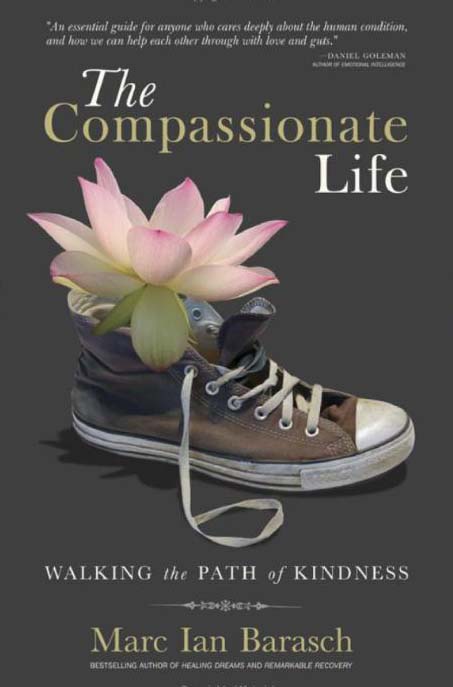
The Compassionate Life, (published by Berrett-Koehler). Chapter reprinted by permission of author. Copyright c 2009, Marc Barasch. To learn more about Marc's work, go to http://www.compassionatelife.com/
To purchase The Compassionate Life from Amazon.com, click here!