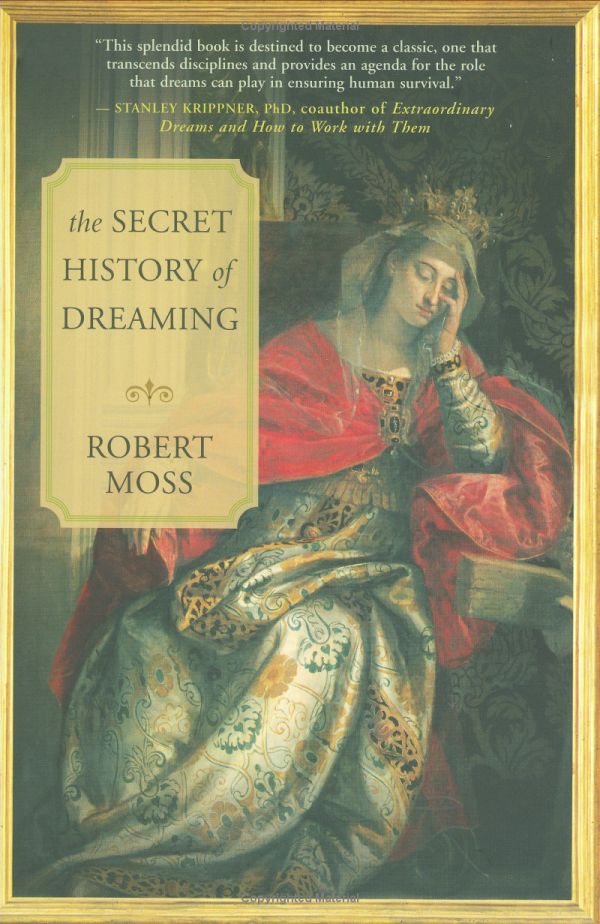
The Secret History of Dreaming*
By
Robert Moss
Book Summary by Charlotte Gallucio, Atlantic University
PART ONE
Secret Engines of History
Chapter 1: Earth Speakers and Dream Travelers
Our ties to the indigenous people of the world go beyond DNA factors that link us to our ancestors. We meet in another sphere of consciousness, and it is here that we discover our vital connection through the ages. We all enter the imaginal realm of creativity we call dreaming.
From the Malaysian Rain Forest people to the Woodland Indians of North America, we see the holistic approach repeated when working with dreams. Nightly out-of-body travel enables them to learn from the spirits of the natural world. Sometimes, they return with songs to drive away evil spirits. Able to exist within a multi-dimensional mode, they see no difference between the workings of the mind while awake or asleep.
Indigenous groups use their nightly journeys to dissolve the boundaries of time and space and create sacred unions with the gods of their physical, mental, and spiritual worlds. While dreaming, they can achieve wholeness and maintain the soul memory of their origins. Before vision quests, they engage in incubation rituals to assure a worthy dream. You might find them alone for great periods holding amulets of their personal guides, or shape shifting. Afterwards, the dream is re-enacted to study the message and provide greater control over the problem solving process.
Dreams serve a number of purposes. They can heal, provide community guidance, and provide spirit guides to those entering, or leaving, the earth plane. At times, a dreamer will invite a shaman to enter the dream with him to retrieve his lost, or disoriented, soul. Dreams work like the technology of modern society. They are tools for learning and entertainment for the community. During Cleopatra’s time, dream schools were set up in the temples to help both children and adults learn the way of the dream.
The stories of ancient dream travelers are precious archeological finds that provide us with leads to the meaning of archetypes and dream study approaches. From them we learn to honor the dream. More importantly, the dream becomes a tool of personal transformation for us, as it did for them.
The people of ancient times provide us with a base for modern dream interpretation. They also reminder us that dreams influence our everyday life, perhaps more than we can imagine.
Chapter 2: Interpreters and Diviners
Many people take dreams seriously today. Divining is another matter. What is the difference? Dream symbols come directly from a person’s psyche and bear a personal significance for the dreamer. Divining means that one derives meaning from symbols in the outer environment. To some, this means fortune telling. We need only to look at the indigenous people, though, to see how dreaming and divining compliment each other. Both work in unity as expressions of body, mind, and soul.
Let us look back in history to see how dreams and divining reveal Divine will. Those from the ancient land of Ur helped the dreamer by entering the dreamscape with them. In this way, they were able to ward off evil energies or aid the dreamer in interpreting the dream. Moving ahead in history, we find Aristotle supporting the work of dream interpreters. He believed that magicians manipulating the truth could even distort some dream images. During the first and second century, Artemidorus held that dreams were like riddles and puns. Good interpreters, he believed, could find answers to these riddles.
In sixth century Mesopotamia, we find a change in the emphasis of the dream interpreter’s approach. No longer did they just tell the dreamer the meaning. Now they drew the meaning out of the dreamer by a series of questions. This tied the dreamer to the dream in a more personal way.
To seers in ancient times, the art of divining was an important tool that complimented dream interpretation. Diviners saw meaning in stars, leaves, water, and the animal world. These confirmed an interpretation, or revealed what was missing from a dream. Objects used in divining differed according to region. One might find stones and bones used in African, I Ching in China, and Tarot cards in Europe. Objects, thrown or placed, formed a pattern. The reader’s job was to decode messages and help the client act upon that message. Without action, the energy of the experience would be lost. This was the essence of their work, for they believed that meaningful insights held the power for real transformation.
History recorded the meanings of dream symbols and divining runes in different ways.
The first was the difficult task of inscribing clay tablets. With the onset of scribes, Artemidoros wrote the Oneirocritica, one of the more famous dream interpretation resources in favor of divination. It also took divination out of the realm of the soothsayer and into the purview of applied science.
However, the subject that gained the most attention in his book was dreaming of “sex with one’s mother.” While seen as a motivating factor in dreams, it was about power and the foretelling of future events. What it signified depended on the positions of the incestual couple. Startling images of this nature opened one’s mind and provided motivation to dig deeper for meaning. During that period of history, interpretations were more open-minded.
In the early twentieth century, Sigmund Freud’s interpretations of dreams were much narrower. For him, everything that occurred in a dream, including sex, was a form of repression.
He also did not believe that a dream could predict the future, but he was wrong about that. When one his clients, Irma, appeared in his dream, he thought the dream was about her. Instead, the dream warned him of his own illness. This illness eventually killed him. While the famous Irma dream did not save Freud, it raised an important question about the role of dreams. Could dreams diagnose illnesses? Carl Jung believed they could.
Jung soon parted ways from the ideas of Freud. He no longer saw dreams as a way to free repression. Whether by means of a dream or by the use of runes, he knew one could tap into the collective unconscious. Here humankind would find their source of wisdom.
Chapter 3: Divine Dreaming
The Bible opens with the book of Genesis, revealing the creation of the world. We sense a strong, all-knowing God is in control. Looking deeper into the stories of the Bible, the Torah, or the Koran, we find the source of the power of God. It is the power of creative imagination. Could this also be the power behind the development of the major religions of the world?
The holy books of these religions reward the efforts of philosophers and historians who ask this question. History reveals many divine dreams recorded in these stories, some of which may have influenced the early formation of organized religion.
We begin with the Hindu religion. Their God, Vishnu, dreams the world we live in, which will continue until he awakens. Built in his honor, ancient temples became places for people to pray, incubate dreams, and sleep. From these dreams, they received guidance and prescriptions for healing. Some believe these were illusions, but it was the illusion that was real to them. At the core of Hinduism are the teachings of the Upanishads. They wrote about states of sleep that led to illumination. Even in a waking state, they believed one could achieve transcendence.
Buddhists have their story of Queen Maya. In Sanskrit, the name Maya means “illusion.” It refers to the ability to manifest images seen in dreams. In the story, Maya dreams of a white elephant with six tusks. The tusks pierce her side alluding to a Divine conception. The dream foretells the future birth of their son Siddhartha, the Buddha. Today Tibetan Buddhists practice dream yoga, which prepares them for a journey into a past life. Buddhists rely on these dreams and visions to reveal messages from tantric masters. In this way, they discovered the sacred text of the Tibetan Book of the Dead.
In each phase of development of Christianity, we find a dream or vision initiating the next stage of growth. The Archangel Gabriel appears to Mary and Joseph, foretelling the birth of Jesus. Soon after, the Magi encounter a star angel that leads them to the Christ Child. It also convinces them not to tell Herod so the Holy Family could escape. The western Church credits the dreams of Constantine for helping them fight against heresy. In his dream, he sees the symbol of a cross on the shields of his infantry. The power of that symbol motivates him to conquer the enemies of the Church.
Early Jewish writings identify Archangel Gabriel as a Master of Dreams, the one who advises souls before birth and during life. He appears in the dreams of people from all major religions. The Koran, the Islamic book of teachings, stems from a dream that Mohammad had of the Archangel. No other religion values the power of dreams, as does Islam. Mandates require leaders to incubate dreams, lift the veil between the living and the dead, and return with a message from a prophet. If you could dream then, surely, you must have a direct link to God.
Convinced of the validity of dreams, early century political leaders acted upon guidance received from dreams to expand territories and maintain positions of state. The benefits received from this guidance convinced political leaders to become the religious leaders as well.
With the onset of all this advice, the Church began to fear the start of schisms, and the loss of authority, from over zealot dreamers. To stop the loss of power, the Church deemed only their dreams, or those of their advisers, valid. The value of the dream of a commoner fell. Diagnosing dreams for the religious governing body, without formal authorization, would prove fatal to those who chose not to listen. Eventually, leaders began to rely less on visions and dreams.
Some historians firmly believe that dreams and visions inspired the birth of organized religions, while others believe that these visions are exaggerated myths. At the very least, one can argue that visions and dreams made a major impact on the political, religious, and social mores of the day.
Chapter 4: The Angel That Troubles the Waters
Atop a fountain in New York’s Central Park, stands a statue of the Angel of Bethesda. She holds lily in one hand, the other hand stretches out over the water in a gesture of blessing. Thousands walk by the fountain each year, but few realize the significance of the angel. It is the angel of healing.
You will find the angel mentioned in John 5:1-9, in connection with a healing by Jesus. The story takes place at the Pool of Bethesda in Jerusalem, where the ill pray, dream, and hope for a cure. People believe the angel stirs the waters into a frenzy using the “troubled waters” to wash away their ailments. At the onset of Christianity, the pool becomes a site for Jesus to heal. Skeptics believe that the bubbling water arose from a spring. They also believe that the biblical story placed Jesus at this site to give more credibility to the church.
The early church struggled to find its place in the minds of its followers. If the church supported the healing power of Jesus, how could it continue to attract those who believed in the power of Bethesda? The answer was prayer. If people regularly gathered at a spot to pray, that spot became a holy site. Perhaps the move was political, but the church also knew that beliefs were important. It did not matter whether healing came from Jesus or the water. It was a win-win situation for them.
The story of Bethesda is not just important to historians, however. It is important in the field of medicine as well. Today, many physicians draw upon intuitive powers to diagnose. They also know that what their patient’s believe is just as important for healing. Medics of the early Greco-Roman era understood the power of beliefs and dreams. People like Hippocrates tracked a patient’s dreams to look for natural cures. He believed that dreams were about the ability of the soul to leave images in the mind. These images served as clues to the state of the body. By the end of the first century, Rufus of Ephesus, carried that idea forward. He interviewed patients’ dream habits and visions, using this information to assist in the healing process.
The next century gave us Claudius Galen, who found a way to blend the philosophies of science and reason. Known as a practitioner in the scientific methods, he knew people would listen to a god before they would listen to their doctor. These gods could prescribe and cure. In fact, he owed his own life to information he received in a dream from the god, Asklepios.
The Temple of Asklepios was one of many healing centers in the Mediterranean that flourished in ancient times. Imagine what the experience is like. Uncertain, and filled with fear, you step into the cleansing pool. You guides ask you to leave behind all that is familiar and enter with an open mind. Along the way, you listen to the testimonies of those already cured. You make offerings to the gods, and then pray. Your expectations grow.
In the great hall, people are singing incantations and hundreds of candles burn. You walk into a rotunda filled with light, and sense that the reason for your being here is about to begin. Now you follow others to a darkened room under the ground, where you begin the process of healing. You dream, you awake, and dream again. During that time, you have a healing vision.
All of this happens in a reverie, but greater understanding emerges. Use of the creative imagination can cure. Following the advice of a doctor can also bring about a cure, but one truth remains. It takes willingness on our part for a cure to take place.
Chapter 5: From the Dream Library
We seldom know what authors use as inspiration, but those who keep journals leave us clues. The pages of found journals not only prove that writers have a rich dream life, but that they use their dreams as a source of inspiration. For writers, dream stories are as real as the experiences of waking life. Many of them also have the gift of second sight.
The Dream of Dumunzi, etched in clay tablets, is the first known recorded dream. It dates back five thousand years to the Sumerian City of Uruk. The story of this dream is an imaginative piece of literature that takes the reader into the hearts and minds of its characters where they explore the mysteries of life.
Storytellers today believe that stories and dreams begin in the same place within the mind. Writers reside in a state akin to a light sleep while awake. Asleep, the writers reside in a waking dream. In this common state of mind, one taps the well of creative imagination. The art of writing and dreaming are now free to work together. The stories of Graham Greens are a good example of this synthesis, for the plots in several of his novels and short stories came directly from his dreams, which he recorded each morning.
Russians writers have the highest amount of paranormal activity in their stories. This is because they show the highest amount of it in their dreams. Their stories reflect the blurred line between waking and dream states. Nicolai Gogol wrote about dreams as a cause of healing, though his own life remained tormented. The stories of Aleksei Remizoz dealt with the afterlife, while the more famous Dostoyevsky created a rich dream life for his characters. All of these authors wrote about topics they encountered in their own dreams, and their writing flourished.
After the Bolshevik Revolution, conditions changed. Stalin suppressed imagination. Unless writers agreed to government ideals, they would not be free to write as before. Rather than give up freedom of speech, they went underground. Censorship silenced their voices, and many of them met a death as unkindly as that of their characters. Most died in obscurity.
Fortunately, writers in other parts of the world fared better. Authors like Emily and Charlotte Bronte learned to preserve the child-like quality of imagination in their writing. They cherished their dreams and filed them in their own dream library for future use.
Chapter 6: How Dreaming Gets Us Through
No one is surprised to hear that creativity is a need for people who work in artistic fields. They depend upon their ability to enter a state of mind where anything is possible. They feel sure about things that have not yet happened, and ideas come to them when they least expect them. Creative people recognize energy in all of its forms. What of the angler or politician, though? Do they also have a use for dreams? It might surprise you to know that the answer is “Yes.” Look at what historians discovered about people, from all walks of society, and their dreams.
There are more stories to tell of people and their dreams, but it is more important to know how people recognize the state of consciousness needed to access the imaginal realm. Dreams and visions come to some when they sleep. Others are awake but in a zone of consciousness ripe for the imagination.
In the waking state, they are able to go into a type of reverie, or a state of unfocused relaxation. People have different labels for this state of mind. Some refer to it as effortless thinking, or visual imagery. Others call it a state of fluid consciousness. This state of mind can arrive spontaneously or through practice.
Psychologists remind us that the brain cannot tell the difference between a thought and something actually happening. Therefore, visualizing doing something is as powerful as dreaming it. It sends the same message to the brain. Mental rehearsal experiments show that muscles of downhill skiers react in the same manner as if they were skiing. It prepares them for what they will meet on the slopes, and increases confidence.
The practice of mental rehearsing is actually covert conditioning. It goes beyond programming by affirmations. People who practice this do more than just believe. They participate in the action of the imagery and instruct future behavior.
Whether you are a gifted seer or you work at developing your creativity, four stages of discovery remain the same:
Creativity is a process that commands more than just thinking outside the box. The people cited above used their dreams in ways that increased friendships, improved healing, encouraged talent, or simply found them food. How will you use your dreams?
PART TWO
Masters of the Three “Only” Things: Dreams, Coincidence, & Imagination
Chapter 7: Joan of Arc and the Tree-Seers
“Sixteen-year-old girl leads an army to victory!” This could be a tabloid headline, but the event is real. The girl is Joan of Arc or her preferred name, Jehanne. The time and place is fourteenth century France. Stories of her visions of divine guidance, and her ability to sway large groups of people, are legendary.
She sits under a tree and hears the voices of Archangel Michael, and those of Saints Catherine and Margaret. The voices come with bursts of human shapes, scents, or light, all of which add to her strength and determination to change the history of her country.
Several images stand out in Jehanne’s story. The first is The Lady Tree, a beech tree in a grove of oaks. It is the place where spirits of “the old ones live.” This is where she hears the voice telling her to wrest the city of Orleans from English control. Here, she also learns that she his to bring the King’s oldest son to Rheims where he will be crowned Charles VII.
To convince a local baron to give her escorts for this journey, she tells him of her vision of English and French armies in battle. In this vision, the French slash the English Army’s food barrels, which hold the Lenten food. She sees herring splashed across the field. Days later, word of the actual battle reaches the baron. Convinced of her ability as a seer, he gives her the armed soldiers. The Battle of the Salted Herring marks her ability to win over male leaders.
While delivering the King’s son to Rheims, Jehanne and her escorts find themselves in an open field. They wonder how they will find evade the traps of their enemy. She predicts that she will receive guidance. It comes in the form of a stag that runs by the English soldiers. Excited by the prospect of hunting, the enemy howls with delight, betraying their whereabouts. The ambush never takes place. The Deer of Patay sent by God defeats the English. Prophesy and military tactics continue to prove a winning combination in fulfilling her destiny.
Taking a second look at the images from Jehanne’s visions, we find that many are similar to those found in Indo-European cultures. The Church often adopted pagan symbols, like fish, and fit them into the beliefs of the time. The Druids gathered in groves of oak trees, which symbolize strength and knowledge. In ancient France, the stag was the most important symbol for it was the only true mark of a king. These and other similarities to common images of the time cause skeptics to doubt Jehanne’s recollections recorded at her trial. Some even view Jehanne’s gift as a mental illness.
Once her mission ended, her star began to fade. Church officials had her arrested and falsely indicted of heresy. Her father, who had his own gift of prophecy, once envisioned her riding off with men-at-arms. If he knew what lay ahead for her, would he have stopped her?
Jehanne saw the future and made it a reality, even during times when she felt the absence of God’s comfort. Whether her visions were real or not, history cannot deny what she accomplished.
Chapter 8: The Beautiful Dream Spy of Madrid
Imagine you slip into bed one night, and just as you close your eyes, you are aware of a man standing by your bed. Without speaking, he draws you to the window to observe the sights in the street below. Then, he takes your hand and the two of you travel through the night to spy on clerics and politicians or, perhaps, you fly off to distant lands. If you were Lucrecia de Leon, this would be a nightly event.
Lucrecia was a young Spanish girl of twelve who lived a simple life. During the fifteenth century, she had over four hundred dreams like the ones described above. Dreams were contact with the Divine, making her special. Royal confessors from the State recorded these dreams for her, which are now on record in the National Archive of Madrid. From these files, we are able to examine the impact her dreams had on the social, political, and religious mores of the day.
It was common at that time to have seers in the family, but Lucrecia’s dreams were rich with stories of the hidden lives of people. They provided gossip and entertainment among locals. She began to act out her dreams in plays, which increased her popularity. People used her to send out their message of limiting royal power. Artists sketched her dream scenes, sometimes turning them into paintings and sculptures. Those curious enough to study them were free to ponder the social implications in them.
Wanting to grow as a world power, Spain relied on her inspired warnings. Her dreams were flights of fancy about strength and greatness, but that soon changed. One evening she had a dream about a high-ranking official. She saw what he was doing in his private quarters. Once he learned this, he hired her as an informant for the State. If she knew what he was doing, she could see what the enemy was up to as well.
When Lucrecia dreamed of the defeat of the Spanish Armada, she became a threat to the King. The dream came true and Spain lost her power, riches, and control of the seas. Life as a spy came to halt, but she had bigger problems. The King replaced her supporters. She was now at the mercy of the Inquisition.
The dreams of a young woman took her to places where only those born into royalty could venture. Fame, however, came with a price. Worn down by time and a nervous condition, Lucrecia signed a confession. Officials embellished her actions with supernatural figures and dealings with the devil. The confession convicted her as a blasphemer. In comparison to Joan of Arc, the punishment she received was light, but after sentencing, Lucrecia de Leon fell into obscurity.
Though there are no known pictures of her, many believe that Lucrecia was a beautiful, sensuous woman who took a great deal of pleasure in the attention garnered from her dreams. She longed for a husband but, but as her dream influence grew, she was drawn into the political affairs of the State instead.
Some accepted her gift, while others were more concerned about the source of her gift. You probably will not find her story told in the wider spectrum of recorded history, but the truth is there, hidden in the archives.
Chapter 9: The Underground Railroad of Dreams
Few people live entirely for the sake of others, but Harriet Ross Tubman was one of those that did. We remember her best for helping fellow slaves escape bondage by means of the Underground Railroad. What we may not know about her is that she completely depended on inspiration and guidance to lead her through the network of safe houses on the route to freedom.
The granddaughter of an African slave, she was named Araminta Ross, and later decided to take on her mother’s name, Harriet. Her roots trace back to a West African group known as the Ashanti. They believe that one inherits strength from their mother. This would be true of Harriet. She showed unusual stamina in confronting the difficulties she faced. The Ashanti also believe that one inherits spirit from their father. Again, this would true, for like her father, she had the gift of sight.
She could journey to distant places while asleep, including the future, but the word “sleep” had a different meaning for her. Harriet had the ability to live in a state of mind where sleep and wakefulness meet.
The visions she spoke of began at age twelve began when a two-pound weight, meant for a runaway slave, hit her in the head. After that, she would often fall into trance-like states and dream. Like Lucrecia de Leon, the young dreamer from Madrid, Harriet’s dreams would lead her to a window from where she would take flight. On one occasion, she dreamt of flying above the land as she traveled north. The map and the landmarks etched themselves into her mind and served as a guide to lead slaves to freedom. Her gift included more than visions, however. Harriet also listened to her intuition to avoid danger and align herself with the right people for her cause.
She returned to the land of her enslavement many times to rescue more slaves, even when new laws made it dangerous for people who aided fugitives. As hard as the trip north was, no one complained. She would not tolerate it. Harriet was kind and humble, but she maintained a death-or-liberty attitude with those in her trust. A slave, turned traitor, could be deadly for everyone. Her focus on emancipation inspired her to do what she had to do. Later, the government hired her as a scout and spy to protect the first black regimen composed of former slaves.
Minty, as they called her, told stories that taught and infused those entrusted to her with hope. She sang often, soothing their worries. No one suspected that messages in her hymns provided a signal for those waiting to move from one station to the next. When Lincoln issued the Emancipation Proclamation in 1863, she knew the seeds of freedom she planted took root, though her work was not over. By historical standards, she succeeded beautifully. By personal standards of living, she lived a hard life encountering one resistance after another.
Others of the Underground Railroad risked their lives for freedom, but none is as widely known as Harriet Tubman is. She not only set aside her own needs, but also completely surrendered to the intangible world of inspiration and dreams to accomplish this goal.
Chapter 10: Mark Twain’s Rhyming Life
Born Samuel Clemens, Mark Twain dabbled in writing as a young man, succeeding by the random events that characterized his life. He kept a notebook of all that he noticed. These thoughts became the inspiration for many of his stories.
His life, like many creative people, was painful and disappointing. Any success he enjoyed as a writer came from to two very unlikely sources. One of those sources was “coincidence.”
Once he planned a trip to the Amazon in search of the coca plant, but ended up on a riverboat as a pilot intern instead. Though he did not see it at that time, this saved him from becoming caught in cocaine trafficking. At times, it seemed more like fate intervened in his life. Walking down the street, a loose page wrapped itself around his leg. The page was from a text on Joan of Arc and it inspired him to write a book on her personal reflections. Then there is the chance encounter with a magazine publisher. After a non-productive conversation with him, he went directly to President Grant and offered to write his memoirs. The book made him a very rich man.
The other source of his success was his ability to lose himself in big thoughts. Twain immersed himself in his dreams, which were more real to him than daily life. He often pictured humanity as a microbe in the body of God. Each microbe being a small living specimen capable of creating a great impact on the larger life it dwelled in. He believed that people could send mental messages to those at a distance and receive answers.
In one instance, he had an idea for a book, but it was not for himself. It was for a friend in Nevada. Twain penned his ideas and as he was getting the package ready for mailing, he received a package from the same friend, with the very same idea. This confirmed his notion that ideas could travel to others. After this event, his beliefs in telepathy and dreams began to appear in his stories. In one of his stories, he did more than allude to the reality of dreams. He outlined recommendations for working with them.
As Twain continued his focus on the workings of the mind, he began to write of mental abilities that could alert us to danger, give health warnings, and provide cures. He saw the wholeness of life and believed in dreams, night travel, and the many dimensions of the soul.
In one book, he described an entire life cycle within a single drop of water. We may not have access to Mark Twains’ journals, but we do have access to his writings. If we look carefully, we will find all the things he “noticed” in his lifetime.
Chapter 11: The Man Who Blew Things Up
Two men each have a dream; one is Carl Jung, the other is Wolfgang Pauli. The former thinks of his dream images as symbolic representations of what is going on in his life; the latter believes his dreams are another reality that enable him to foretell the future. Their intertwining stories tell how they influenced each other in both their personal lives and career choices.
The men argued over many assumptions. The most common ones are over the terms synchronistic and coincidence. Synchronicity, coined by Jung, holds that our minds create connections between ideas that manifest instantaneously. Pauli refers to these events as a selective observance of the mind, which he calls coincidence.
Jung, an analytical psychologist, studied the collective unconscious and proposed theories on the structure and dynamics of the psyche. Pauli was a scientist concerned with the world of quantum physics and the fine-structure constant, which dealt with the interaction of electrons and light. They came from very different worlds; yet they forged an unusual friendship based upon common interests in such things as the I Ching, dreams, alchemy, and magic of the Renaissance period. Most of the quarter of a century that they knew each other, their time was spent debating and arguing the nature of reality as they sought to find a common ground between them. It is said that both men displayed a passion for their work, were extremely energetic, humble enough to look to the past for clues, and arrogant enough to take risks necessary for breakthroughs.
Dreams became a major point of interest in their relationship. For many years, Jung held to the belief that dreams corrected one’s mental balance with the use of symbolic images. Unlike Pauli, who believed that dreams could foretell the future, Jung would only reluctantly agree to that concept. Instead, he drew upon the dreams of his patients, as well as his own, for insight into underlying behavior that troubled them.
Jung saw the dream as a portal into the collective unconscious where the meaning behind archetypes thrived. Pauli, on the other hand, was skeptical. He found dreams useful as a resource where he could find the confidence to move beyond existing paradigms in his work. Though viewing them from different perspectives, dreams provided a connection between the two.
Pauli once had a dream about a World Clock, which gave him a great feeling of harmony. The image revealed an intertwined horizontal and vertical disk. This immediately intrigued Jung who viewed it as a multidimensional symbol of timelessness.
Of the two, Pauli appeared to have the most disruptive events going on in his life. None is more fascinating than what has been termed The Pauli Effect. Unusual events happened around him, all of which matched his emotions. Laboratories exploded, equipment failed, or cars burned when he felt anxious. It was never determined whether this was the result of intense passion for his work, a display of psycho kinesis, or Renaissance magic. Once it was over, he experienced a great sense of relief. Remarkably, Pauli was never injured himself in these unexplained catastrophes.
As the stories of these men unfold, one cannot fail to see how each struggled to step into each other’s world. They tried to unify their respective fields of psychology and physics. In the end, each man’s death cast the shadow of his own beliefs.
Pauli died in the hospital asking the same question that plagued him throughout his life: “Why did the fine structure constant have a value of 1/137?” The room number of his hospital room was 137. Jung died three years later. A short time before his death, he dreamed of a house waiting for him and the toppling of a tree that he loved to sit under. Perhaps, somewhere, they are still debating the meaning and answers to the questions that drew them together in the first place.
Chapter 12: Winston Churchill’s Time Machines
Born prematurely with an inferior body, and emotionally neglected by his parents, Winston Churchill relied on his imagination to make him one of the world’s most influential people. As a child, he lived in an inner world of make-believe. He later drew upon those memories for the strength and courage he displayed as leader of the United Kingdom. His political decisions were not always rational or sanctioned by his peers, but his actions were legendary. Few accounts of his life, however, give us a glimpse into what motivated and inspired him throughout the years.
As young as fourteen, Churchill told a friend that he was able to dream the future. He knew he would sit in a high position of State one day. From visions of his deceased father, and other prominent ancestors, he studied the workings of character. He crossed dimensions with ease and used what he saw to help change unseemly future events. He forecast the development of wireless electronics; saw the danger of nuclear bombs, and sensed the escalating horrors in Germany before WWII. He also predicted the cold war, the collapse of communism, and the potential threat of Islamic fundamentalism to democracy.
Churchill was a prolific writer, winning a Nobel Prize in Literature for his efforts, but he also remained open to the writings of others. The science fiction writer, H. G. Wells, sparked his imagination with new ideas for warfare and Churchill found himself borrowing phrases from Wells for his speeches.
His gift of prophesy served him well. Yet there was a contradiction in his beliefs for he also believed in coincidence and luck. He called these moments “agate points.” They were sharp reminders of how a single action, and being in the right place at the right time, could affect the future, like the time he lost his gun.
It happened while he was a war correspondence during the Boer War in South Africa. Unable to defend himself without a gun, a South African general captured him. He escaped, but hopped on a train going in the wrong direction. He got off and knocked on the first door he could find. It was the home of the only Englishmen in the area. Churchill was safe. Three years later, while attending a luncheon for South African generals, someone introduced him to General Botha, the very general who took him prisoner. They later became good friends, but if Churchill had his gun with him, and used it, it may have set off an international incident.
This idea of viewing history in the context of what might happen, rather than from what did happen, empowered him to see the bigger picture. He liked looking for patterns of behavior in people and events around him. Possible actions were as real to him as those that already occurred. In addition to his prophetic ability and his trust in luck, he had one more gift for others.
He had the ability to transfer moral courage, confidence, and enthusiasm to those around him.
From him we learned the lesson of how to imagine the future and live creatively. It did not make his life easier, but it gave him access to greater awareness. As a result, he made every decision with certainty, even when others did not agree with him.
The world knows Winston Churchill as a brilliant political leader. Although few know about the council he received from the alternate world he lived in, history will not soon forget the influence of his gifts on world affairs.
Epilogue: The Future History of Dreaming
Dreams are the unifying threads that weave their way into the warp and woof of our yesterdays, today, and tomorrows. Stories of successful leaders gathering their communities to listen to guidance from dreams are becoming more accessible. Sadly, so are the stories of leaders who ignore the gift of sight.
A large portion of today’s societies recognize the benefit of drawing upon the well of creative energy through the symbolic language of dreams, waking visions, coincidences or synchronistic events. They, like the societies of the distant past, know that the mind has a great deal of influence over the body and can use the information derived from transpersonal means to unearth the secrets of the past yet to be discovered, to inspire us toward future progress in the humanities and sciences, and to offer us guidance in everyday life.
Tapping the energy of imaginal resources not only offers us the possibility of living a more aware and alert life, but also brings us to the realization that it is our responsibility to do so, for the very future of mankind may very well depend on it.
* To purchase this book from Amazon.com, click here!