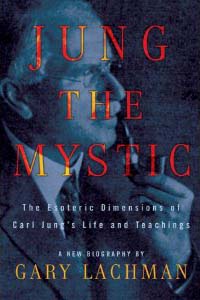
Mystical Jung Demystified:
In conversation with Gary Lachman
Author of JUNG THE MYSTIC
What inspired you to write this book?
I first read Jung in my early teens, around the same time as I was reading Hermann Hesse, Tolkien, Kerouac, Alan Watts, and other counterculture icons. I found his work inspiring and the idea of "becoming who you are" -- that I also encountered in Nietzsche -- was a guiding light that helped me over quite a few hurdles. However, over the years, while I still found Jung an important thinker, I also became increasingly exasperated with the obscurity of his writing. He had something important to say, but he seemed to have difficulty saying it clearly. I've found that the best way to understand what a thinker is saying is to write a book about it, and after writing biographical studies of Rudolf Steiner, P.D. Ouspensky, and Emaunel Swedenborg -- all of whom share common concerns with Jung -- I thought it was time to tackle Jung. I had recently written about him in my Politics and the Occult and welcomed the chance to do a full length study.
Why do you think it is important for us to understand the mystical dimension of Carl Jung's life and work?
This was especially needful as in most of the books I read about Jung, his occult and esoteric interests -- the two are different but related -- were either used as a stick to beat him or ignored or swallowed uncritically. Jung himself had very little good to say about people like Steiner -- who he claimed was schizophrenic -- or other figures in the esoteric tradition, which I found annoying as it was clear to me that he himself was a part of that tradition. Jung's need to be regarded as 'scientific' led him to criticize the work of others who were more or less doing pretty much the same thing as he was; but while they were openly 'esoteric', Jung was in a way even more esoteric than they, as he obscured his own interests in these matters until the last decade and a half of his life. So, along with spelling out the similarities between Jung and Steiner, Swedenborg, and Gurdjieff -- Ouspensky's teacher -- I also was interested in looking into this character trait in Jung, the 'split' between his inner and outer self: the scientific face he turned toward the world, and the 'mystical' one who engaged in visionary practices, just as Steiner and Swedenborg did.
Why is Jung often called "the founding father of the New Age?" Do you think the New Age movement would have taken a different form without Jung's influence?
Ironically, it was Jung's mystical side that had the most influence. He has never been taken up by the intellectuals or academics, but by the early 1960s -- shortly after his death -- he was one of, if not the central figure responsible for the reawakening of interest in a variety of esoteric or occult ideas. He's called "the founding father of the New Age" because it was through him that a wide range of ideas related to what became known as the New Age first reached a wide readership. People like Helena Blavatsky -- the founder of Theosophy -- were rediscovered then, as were many other figures such as Gurdjieff and the notorious Aleister Crowley, but Jung's 'scientific' credentials, and the fact that he was up there with Freud, gave a respectability to his introductions to works such as the Tibetan Book of the Dead, I Ching, and other 'Eastern imports', and led to their ongoing popularity in the West.
Jung himself, I have to say, would have grumbled about most New Age philosophy, as it is sadly naive and lacking the kind of rigor he applied to his own work. And I should add that there is nothing new about a New Age as the idea has a long history in the West; Jung himself was talking about one in 1940, and he was one of the first to spread the idea of a coming "Age of Aquarius," which he identified through his study of astrology.
What new information does your book offer that readers won't as readily find in other works about Jung?
I felt it important to clarify Jung's ambivalent relationship to the occult and esoteric ideas, as he seemed to play both sides of the fence throughout most of his career. So what I've done in my book is to take Jung's occult interests seriously, but not uncritically, and put them in the context of his times, and show how they link up to other, more openly 'esoteric' thinkers, such as Steiner, Gurdjieff, and Swedenborg. Some writers on Jung seem to feel they need to justify or rationalize Jung's ambivalence, and others more or less call him duplicitous outright, while others mention these pursuits but fail to explore them. Again, I think neither approach does Jung nor the reader any good, and while I don't pull punches when it comes to Jung's 'doublethink' I also make clear why I feel his interest in the occult or esoteric ideas is important and should be better known.
In general, what I aim to do in all my books is to bring the esoteric 'out of the closet' as it were and make it part of the ongoing conversation of the western intellectual tradition. Esoteric ideas deserve to be better known as they are part of our cultural and spiritual heritage -- as anyone who looks at their history will see -- and they can also enliven our mainstream cultural life, which seems, for the last century or so at least, to have been dominated by a kind of nihilism and apathy, the 'been there, done that, got the T--shirt' jadedness that informs so much of post--modern life.
What are your thoughts and impressions of last year's Red Book? Do you think Jung the Mystic will offer further insight into the contents of what some feel was a controversial and complicated epic work?
The Red Book, which, after decades of hovering in a mythical semi--existence, was finally published last year, is a good case in point. It is a remarkable work, and rightly deserves the attention it has received, but it is not, in my opinion -- or at least should not be seen as -- Jung's magnum opus, nor as a kind of Jungian Bible. Jung was a thinker and we serve him best by critically examining his work -- that is, by allowing it to make us thinkers as well, not by accepting it as revelation. Sadly, it is this kind of reception that wraps Jung (and others like him, such as Steiner and Gurdjieff) in the mantle of the 'guru', which suggests to people who might benefit by understanding his ideas that he is a 'flake' and can profitably be ignored. That is unfortunate, because Jung himself said he did not want followers -- he was too much of a Nietzschean for that -- but to be understood. If we simply accept a thinker's work as revelation, we do it and ourselves an injustice.
In my book I place The Red Book in the context of Jung's life, examine his ambivalent attitude toward it, explore its links to other, similar works, address some of the rhetoric that has grown up around it, and regard it in the light of other products of 'outsider art', work produced under extraordinary mental strain, as indeed The Red Book was, and ask what it can tell us about Jung's central ideas.
You were a founding member of Blondie and made the Rock n' Roll Hall of Fame. How did you become the esoteric philosopher that you are today?
As I say, I was reading Jung in my teens, and have been interested in ideas about philosophy, psychology, and the history of consciousness ever since. Before I became a musician I was living in NYC, writing poetry, reading existentialism, and dreaming of becoming a writer. All during the time I was a musician -- 1975 -- 1982 -- I read constantly, and more often than not, would spend an evening in a hotel room reading while my band mates were out causing trouble. (You can read about my experiences in my book New York Rocker.)
It was while in Blondie that I became interested in the occult and esoteric philosophy, through reading a brilliant book, The Occult by Colin Wilson, which looked at it in the context of the philosophy of consciousness. I named my own band The Know because of my interest in Gnosticism, which I came to through Jung, and my song "(I'm Always Touched by Your) Presence, Dear," which was a top 10 hit in the UK and Europe , was about telepathy between my girlfriend and myself. When I outgrew rock and roll at the age of 26, I lived off my royalties for a few years, reading voraciously, and travelling. I went on a mini--'search for the miraculous' for a few months, which had me exploring stone circles and ley lines in England -- where I also visited and became friends with Colin Wilson -- gothic cathedrals such as Chartres and Notre Dame, trying to grasp their esoteric symbols, and the site of Gurdjieff's Institute for the Harmonious Development of Man in Fontainebleau. I became involved in the Gurdjieff work for a few years then returned to university and earned a degree in philosophy.
It was while working at the Bodhi Tree Bookstore in Los Angeles that I started writing book reviews and articles for magazines like Gnosis, ReVision, Quest and subsequently, after doing graduate work in English Lit at USC and working as a science writer for UCLA for a time, I decided, at age forty, to take a shot at being a full--time writer. This decision led to my moving to London, where I've been since 1996. During my years here I've written twelve books, numerous articles and reviews, lectured widely, and for a few years (1996--2000) was a musician again, first as part of the Blondie reunion, then with my own band, Fire Escape. But having two children led to my dropping out of music again and devoting myself entirely to writing. And although I've been inducted into the Rock and Roll Hall of Fame, I don't miss being a musician, as ideas are my first love and writing books is a passion.
To order Jung the Mystic from Amazon.com, click here!