By
Edward Salim Michael
(Inner Traditions, Publisher)
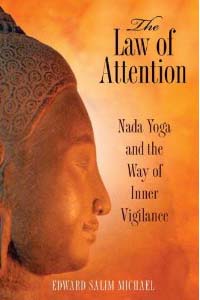
How to achieve a direct inner experience of your higher nature and the after-death state from which you originate and will return.
The Law of Attention provides techniques for listening to the primordial sound within. It offers yoga and meditation techniques that are still little known in the West.
This book--at once simple and powerful--stands as a monument to the lifelong spiritual struggles of Edward Salim Michael, struggles that he heroically surmounted on his path to enlightenment. Due to the circumstances of his birth, Michael had no education, no mother tongue, and no book learning when he was drafted at the age of 19 into the British Royal Air Force during World War II. After learning to read and write he became an accomplished classical composer in France. In 1949, after seeing a statue of a Buddha for the first time, he experienced a powerful awakening of his innate Buddha Nature, which inspired him to begin a sustained and extremely disciplined meditation practice. Michael abandoned his career as a composer and went to India, the home of his maternal grandmother, where he lived for seven years fully focused on his spiritual awakening.
Michael's spiritual teachings reveal techniques of yoga and meditation that can open the door to one's higher nature and to directly experience the after-death state. Nada yoga (meditation on the inner sound) is one of the core techniques for this realization. There is a vast luminous consciousness already within us, but it is obscured by the clouds of our incessant thoughts. With sincerity, moral integrity, and inner vigilance, which, when embodied, implies that we have internalized the basic tenets of the law of attention, we can move beyond the promptings of our lower nature and break through the clouds of our ordinary mind to realize our own divine nature. Emphasizing inner attention and an awareness of attitude, Michael's practices can help aspirants make direct contact with the divine source each of us unknowingly carries deep within.
If Buddha or Jesus or any of the original spirirual teachers of the past were alive today and living in a Paris ghetto I'd like to believe that this is the sort of book they'd write. Not that an unknown like Salim Michael, who qualifies on both latter accounts, puts himself in that league - he doesn't. Nor is the rather 'samey'‑sounding title (which he chose) a lot to go by. Both style and content are so 'archaically' direct and simple as to be almost poetic ‑ with the result the whole rings refreshingly true.
The comparison with Buddha and Jesus is that like them (unless my information is woefully inadequate) Salim Michael learnt nothing of value from books; only direct experience, or 'knowing' will do. Indeed, in Salim Michael's case, book‑learning was impossible until he was in his 20s because he was totally illiterate, able neither to read, write nor add up. Thus it is he writes as I would like to imagine all the truly great teachers of the past would have written (if they would have written at all, which must be in some doubt). He is in absolutely no doubt of the existence of the Divine Source, as he calls God, because he has experienced that 'knowing'.
The book is consequently packed with uncompromisingly honest observation, insight and advice I find hard to fault, written in a style that moves as much as it instructs and informs. Thus, in his preface: "I have found that people have a curious tendency that as soon as they can give a thing a 'name' they believe they know all about it and can then, with a clear conscience, leave it aside and forget it. Thus 1 have deliberately avoided calling certain things by their commonly‑used names to stimulate the desire and the feeling in the reader to seek.
Again, in the introduction: "Before the aspirant can ... touch and understand even the fringe of mysticism ... it is neccessary for him to realize, from the innermost depths of himself, that his spiritual efforts may not bring him much profit - and may even remain sterile - if they do not go hand-in-hand with the development of moral integrity."
And in 'The attention and its importance': "(The seeker) must realize that knowingly or unknowingly he will feed and crystallize the particular state he allows his attention to gravitate towards, allowing, it to take root in him and grow."
Chapters on one's attitude when alone ("he will be greatly deceiving himself if he believes he can conduct himself in his private life in any way that suits him.. . ."), while walking outside ("the imperative need there is to remain in a state of self - recollectedness in action also.. and not only when quietly meditating behind the walls of a monastery"), seeing and hearing ("he generally looks but does not see, he listens but does not hear") illustrate graphically Salim Michael's total 'knowing' from his own experience.
Strangely, and this is perhaps an example of the 'something for everyone' quality that is the mark of this book, the sentence that struck me most was not from the chapters on such 'philosophical' questions as 'Man and woman', 'Mother and child','Food and man' as I would have expected, but the final remark in his passage on 'The trace that thoughts, words and deed leave'.
Summarizing his (by no
means original) belief that everything we think, say or do has a ripple effect
on a variety of seen and unseen levels, he makes the point that while Divine
light, or grace, is hard won ("with so much sweat and silent suffering") it must
then be given back unreservedly to others, "asking for nothing in return". And
he concludes: "What the Earth gives it always takes back in some form or
another; but what the Sun gives is generously given, and never taken back."
I unashamedly confess a lump came to my throat at that point for I realized that
this is precisely what Salim Michael has achieved and what this rare book
represents.
(unknown author, writing at http://www.edwardsalim-michael.org/bookreview1.htm)
ln reviewing a book of spiritual teaching such as this one faces a profound disquiet. There are probably few people on this Earth who are capable of judging this presentation of the author's teachings from an equal or superior position of personal development; 'whereof one does not know, thereof one must remain silent'. Which is to say that this book impressed me with its power and integrity. However, the central theme of the teachings is the absolute requirement for personal honesty, the spiritual 'hygiene' which is a necessary preparation and constant factor for those drawn by the desire for the liberation from ignorance - which is the sin of 'self-forgetfulness'. Thus the reviewer must adopt the position of an honest, critical meeting with the author, without seekinq to judge what one cannot.
Other comments:
Salim Michael with no formal education has devoted his life to the search for spiritual enlightenment and thence teaching to a small band of devoted pupils in Paris. The completion of this book took a painful four year'struggle, compelled mainly by the desire to leave something of his teachings to his pupils, as well as a spiritually lost 'agonising humanity' after his death. The reward of this labour of love is a work which is clearly and simply written through which the light of the author's spiritual experience and development shines through, despite detracting factors of language.
Salim Michael's background and teaching is in the Hindu yogic tradition. However, in structure and content, this book is akin to ancient works associated with legendary teachers, in that it does not directly deal with specific techniques, but with fundamental issues of attitude and approach to spiritual development. With this in mind (and remembering that the work, is indirectly, an account of the author's own struggles) the book appeals to all who feel the ineffable pull of the divine within them, and not merely the yogic aspirant. Readers who are familiar with the yogic philosophy and practice will recognize much, but so, also, will all who seek beyond doctrine, dogma, and intellectual understanding for the personnal experience of the divine 'higher self' which resides in all human beings. Quakers, in particular, will recognize Michael's teaching of the development of a 'silent witness' in everyday life.
The strong moral imperative (so different taken from the personal, existential position, as opposed to the authoritarian position of doctrinal law) to be aware of one's own ignorance and the demands of a selfish 'lower nature' and the painful process of 'dying to oneself' in the need for redemption, will equally impress.
(Luke Davey, http://www.edwardsalim-michael.org/bookreview2.htm)
"The
Law of Attention is a remarkable book filled with clear guidance
that presents a strong call for the total dedication of one's life in the quest
of supreme enlightenment. With Edward Salim Michael's uncompromising emphasis on
integrity and effort this is not a book for the fainthearted or dilettante, but
I would recommend all serious aspirants to read this book again and again both
for its inspiration and its precise instructions. Although not a specifically
Buddhist text, the path mapped out and advice so meticulously given render it a
suitable companion and guide for any spiritual traveler."
Jetsunma Tenzin Palmo,
founder of Dongyu Gatsal Ling Nunnery (subject of Cave in the Snow by Vicki
Mackenzie) and author of Reflections on a
Mountain Lake
"Edward Salim Michael's
teaching goes straight to the heart, making us realize the commitment, energy,
and love it takes to realize the truth at the deepest level. This book is a
spiritual friend and guide for all seekers of Truth."
Ajahn Sundara,
Theravada nun, Amaravati Monastery
"This fine book offers,
without doubt, the clearest and most comprehensive description of 'Nada Yoga'
(meditation on the inner sound) that is available in the English language. This
is a practice that is known in Vedic, Buddhist, and other traditions to be a
powerful and liberating spiritual discipline and is also one that I have used
for more than 25 years, to great benefit."
Ajahn Amaro, co-abbot
of Abhayagiri Monastery in the
Forest
lineage of the Theravada Buddhist tradition
"The
Law of Attention is a remarkable guide for all those who wish to
find the treasure that lies within each of us. Edward Salim Michael has given us
a guide to the path that leads within and words of encouraging instruction when
the way is difficult. His words reflect a life dedicated to spiritual practice."
Rev. Serena Seidner,
Shasta Abbey
About Edward Salim Michael (1921-2006): He began transmitting the fruits of his inner experiences and mystical understandings to his pupils in 1974.