BOOK TALK
by Gayl Woityra*
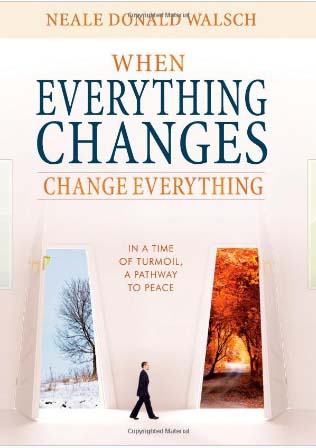
When Everything Changes, Change Everything:
In a
Time of Turmoil, a Pathway to Peace
Right now every single one of us is living through extensive and intensive changes in our lives. The world around us constantly challenges us with new technologies and new systems, changes that are often most difficult for older citizens to handle. In developed societies around the world ordinary citizens, experiencing the economic downturns, are facing loss of homes, jobs, retirement savings, and all forms they consider to be "security." Add to this all the normal everyday changes that happen to us all -- ill health, loss of loved ones, relationship struggles, and indeed, we are all hit with stresses from changes in our lives, changes we probably never planned for and don't want at all.
Author and spiritual teacher Neale Donald Walsch offers us a path to sanity in his new book, When Everything Changes, Change Everything: In a time of turmoil, a Pathway to Peace (Hampton Roads publishing Company, Inc. 2009). Walsch also authored the best seling Conversations with God series. Presented in the form of a friendly, easy to understand conversation with the reader, Walsch offers encouragement, practical steps, and a "fresh and startling perspective" on change.
Acknowledging that "while change has always been a part of human life, " Walsch points out that "social scientists say that the rate of change is increasing exponentially." What used to take years only a century ago, now happens in days, hours, or even minutes. This speed of change is what creates the stress that all of us are experiencing currently as we try to process the many changes in our lives that are hitting us with both speed and intensity. Walsch's intention is to provide "specific instructions on how to use mental and spiritual tools to change the way change changes you." His ideas in the book are "based in ancient wisdom, modern science, everyday psychology, practical metaphysics, and contemporary spirituality."
Walsch begins with the premise that "Change is what is," and that it is "not going to stop . . . . What can be changed is the way you deal with change, and the way you're changed by change." He divides his presentation into two fairly equal sections. Part One discusses "The Mechanics of the Mind" and "how knowing about that can help you change your experience of the change you're experiencing." Part Two explains "The System of the Soul" and "how knowing about that can help you create the changes in your life, rather than endure them."
Within these two approaches to the issue of change, Walsch converses with the reader about the "Nine Changes That Can Change Everything." Here's the list:
- Change your decision to "go it alone."
- Change your choice of emotions
- Change your choice of thoughts
- Change your choice of truths.
- Change your idea about Change Itself
- Change your idea about why Change occurs
- Change your idea about future Change
- Change your idea about life
- Change your identity
For the purpose of our discussion of Walsch's book, we will touch upon these
nine changes and some of the insights Walsch shares with readers. In section one where the author describes how our minds work, readers are likely to relate immediately to his discussion. His early words relate to Change #1: Change your decision to "go it alone" helps readers understand that "this is not something that is just happening to you." We are all in this same speeding boat. He encourages us to recognize our fears and urges us to "connect," if only by learning more about this situation, perhaps by reading this book.
The next two changes are big points for each of us to ponder. Change #2 says: "Change your choice of emotions." Many folks might be surprised that Walsch insists "you can change your choice of emotions." While neuroscientists may tell us that emotion comes before thought, Walsch says the opposite is true. Most of us could attest to that very fact. When we think of a sad situation, we then feel the sadness. Therefore the author urges readers to "change your thoughts" and that becomes Change #3.
In the very short discussion of Change #3, Walsch introduces three "realities" that weave their way throughout the book: Ultimate Reality, Observed Reality, and Distorted Reality. Ultimate Reality holds the greatest truth about "what is 'so' about what is going on and why;" Observed Reality is "what is readily apparent;" Distorted Reality is "what we imagine is going on." Unfortunately, most of us spend a lot of time in Distorted Reality.
Change #4 tells us to "change your choice of truths." Most of us never consider that truth involves choices. Walsch identifies three kinds of truth: Actual, Apparent, and Imagined. Once again, most of live at the Imagined Truth level. Walsch unequivocally says, "There is no such thing as absolute truth," and so we can set aside "actual" truth for now. What we all need to work on is Apparent Truth: "What we have observed,"-- what is going on now and you can actually observe it.
Now the author spends the rest of Part One of his book explaining the mechanics of the mind, and how the mind can help or hinder us as we deal with changes in our life. One paragraph gives us a clue to this process. "Events do not have meanings. Events are events, and meanings are thoughts. Nothing has any meaning save the meaning you give it. And the meaning you give to things does not derive from any event, circumstance, condition, or situation exterior to yourself. The Giving of Meaning is entirely an internal process. Entirely."
Hence we gather that the process is something inside us, inside our mind, and that is what we need to master. Walsch says, "The trick is to raise your consciousness from the lowest to the highest level of awareness, no matter what is going on around you." He urges us to remember that "reactions are instinctive; responses are thought out." So if we take the time to think, the mind has the ability to decide how to feel, how to respond. For example, he points out that we can each choose to change "worry into wonder, expectation into anticipation, resistance into acceptance, . . . addiction into preference, . . . judgment into observation, and reaction into response."
In an interesting discussion Walsch helps readers become aware that most of us base our "truth" and "reality" on past data -- reality as we have experienced it. This results in a very subjective perspective toward what is actually happening in the present. More objective reality only comes from Observed Reality, that is dealing with the present and not processing it through past judgments. Throughout these pages the author gently guides readers to understand how the brain works and how to use that understanding to make new choices and "embrace new truths."
We now reach "Part Two: The System of the Soul, and how knowing about that can help you create the changes in your life, rather than endure them." Here Walsch describes briefly and simply his understanding of God and the Universe. He says, "God is the Largest Manifestation of a System that Replicates Itself on Smaller and Smaller Versions Through a Process That Empowers the System Itself to Exist and to Expand." In other words, "God is in everything; life is in everything." Walsch says, "The soul knows the Actual Truth while the mind stops at Apparent Truth. Unless it does not." His answer to everything is: "All change is for the better. There is no such thing as change for the worse."
This pronouncement leads to "Change #5: Change your idea about change itself." By leaving the realm of mind and entering the realm of Soul, we have a new perception of change. "We see that change is not an alteration in the condition and circumstance of our lives; it is the condition and circumstance of our lives." Hence, change is the norm. There is no need to wonder "whether life will contain change, but [rather] what kind of change life will contain."
The author asks readers to consider past experiences of change, especially the "worst moments" of our lives. Is it not true that most of us will discover that from those dreadful moments derived some of the "best things that ever happened to us," -- new insights and opportunities, leaps in self-understanding, or turning points in our lives? Walsch points out that "Life itself can fundamentally alter itself in only one direction: the direction that evolution requires." "Change is the fundamental impulse of Life itselfl"
Change #6 says: "Change your idea about why change occurs." Most of us don't understand or even perceive improvement when it is occurring. Often our personal growth comes through difficult and challenging circumstances or events that we might prefer to avoid. So who or what is running the show? Walsch says the Soul makes the choices to experience these things, these changes. He says "There is a reason that things are happening the way they are happening." His point is that although the mind is a "marvelous mechanism," we are more than our mind: " we are also a soul." The Soul knows more about us than the mind. "The functi0n of the soul is to help you remember all that you already know -- but not too much, too fast."
The insights that originate in our soul provide a different perspective from that of the mind. Walsch says, "The largest message of this book [is that] perspective is everything." In fact, "in the matter of changing everything when everything changes, perspective is the key." To do that "we must adopt an integrative approach to the living of our lives." To explain this point the author lists what he calls "Life's Four Fundamental Questions:
- Who am I?
- Where am I?
- Why am I where I am?
- What am I doing here?
Walsch's discussion of these questions is a significant contribution to our
understanding of ourselves and Life itself.
He
provides a clear metaphysical discussion that should provide helpful
insights to every reader.
A kind of summary of
his points is this sentence:
"The Realm of the Absolute (also known as the
Realm of Spirituality) is where KNOWING everything takes place, and that the
Realm of the Relative (also known as the Realm of the Physical) is where
EXPERIENCING everything takes place."
And so, he suggests "that souls come to the earth in order to gain
a world of experience."
After his in depth explication of spirituality and soul purpose, Walsch identifies Change #7: "Change your idea about future change." You know how it is that we tend to dread what changes might occur in our future? We often work diligently to keep things as they are because we feel more secure with that we've already experienced. But Walsch reminds us that "it is only in your mind that it [change] does not seem welcome." He points out a truth that some of us learn, especially in old age: "that everything that's ever happened to you has happened for the better." Anything we have labeled as "bad" is a perspective we've added with our thoughts. And usually we have resisted whatever was happening. Walsch says, "I have learned that everything ends well if I let go and let God; if I simply allow whatever change is occurring in my life to occur without opposition."
It's no surprise that Walsch's insight leads to Change #8: "Change your idea about life" and Change #9: "Change your identity." Reading this delightful book that is so useful in today's chaotic world, we learn that life IS change. Everything is always changing. It is what provides us all with the opportunities tp learn and evolve. This lovely book helps us "see life and everything in life as an opportunity, . . . as a gift." And after we change our ideas about life and its purpose, we are "only one step away from changing [our] idea about . . . our very identity. And that, indeed, changes everything!
 *Gayl
Woityra writes a book blog,
"Love
That Spirit," from which she graciously
allowed us to reprint this "book talk." Copyright C 201 Gayl Woityra, All
Rights Reserved.
*Gayl
Woityra writes a book blog,
"Love
That Spirit," from which she graciously
allowed us to reprint this "book talk." Copyright C 201 Gayl Woityra, All
Rights Reserved.
To order a copy of When Everything Changes from Amazon.com, click here !