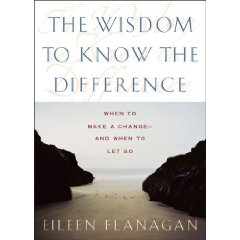
The Widsom to Know the Difference:
When to Make a Change and
When to Let Go*
by
Eileen Flanagan
(An excerpt from the introduction)
When I experienced my first professional failure at twenty-nine, it was a devastating shock, but one that spurred my spiritual growth. It's been part of my faith journey to learn the spirituality of acceptance, realizing that there are times when letting go and trusting are the best I can do. This does not mean adopting passivity, surrendering my destiny to fate. It simply means recognizing that while I can chart my own course in life, I don't control the sea around my little boat. I can't guarantee that I won't ever get knocked into the waves, though I can learn to swim in case I do. I've found that recognizing both my power and my powerlessness is useful when facing life's storms.
My recognition of this paradox began when I became pregnant with my first child. I realized I could not prevent my water from breaking in the supermarket or guarantee that my favorite doctor would be on call when I went into labor. More sobering was the realization that I couldn't guarantee my baby's health, no matter how many prenatal vitamins I took. At the same time, my attitude and my choices did matter, so I tried to do all the right things. I drank milk instead of coffee and juice instead of wine. I stopped volunteering in a prison because it exposed me to secondhand smoke and took a day-long retreat in the woods to calm my spirit. I knew intuitively that worrying about the baby wouldn't be good for either of us, so I began meditating on the Serenity Prayer, the most famous version of which says:
God grant me the serenity to accept the things I cannot change,
Courage to change the things I can change,
And wisdom to know the difference.
The prayer summed up what was for me the major predicament of pregnancy: learning when to passively trust in God (like when I first passed my due date) and when to take action myself (like when my pregnancy went so long as to put the baby at risk and my doctor recommended labor-inducing drugs). The challenge of childbirth -- learning when to push and when to just relax and breathe -- seemed a fitting metaphor for many other human dilemmas as well.
The wisdom to know the difference between what we can and cannot change is central to my definition of a well-lived life. When we accept our circumstances, we spare ourselves frustration and anxiety, though we suffer needlessly when we put up with what we shouldn't. Too often, however, we get the equation backward. We feel anxious about not having a perfect figure, while snacking on unhealthy food. We obsessively check the balances of our retirement accounts, while spending money on things we do not need. We try to change other people, instead of changing ourselves. When we get the equation right, putting our energy where it can do the most good, our lives are less stressful and more meaningful. We have more time to make a difference I in the world when we re not wasting it on fruitless complaints.
Unfortunately, few voices in our culture help us to develop this wisdom. A glance at the bookstore shelves reveals the problem. On the one hand, most self-help authors preach taking control, arguing that you can become rich or married or thin or smart if you just have the right attitude. One book sums up the self-help creed in capital letters: IF YOU KNOW WHAT YOU WANT, YOU CAN HAVE IT. But what if I want my father to be alive again? What if I want world peace? Knowing what I want will help me to write a book or win an Olympic medal, but it is not always enough. Religious books generally do a much better job of promoting acceptance and serenity, but many go too far the other way, encouraging readers to accept their suffering as unchangeable, even God-given. A few of the Christian books on marriage make sexism sound like a divine gift intended to teach women patience.
The Wisdom to Know the Difference is a different kind of spiritual book, one that argues that it is important to distinguish between letting go and giving up. On the one hand, this book rejects the idea that God decided your lot in life long ago, so if you are poor, or sick, or in a bad marriage, it is because "you were put on this earth to suffer," as my mother's teacher put it. That theology may lead to surrender, but not serenity. It certainly will not empower you to eat well, get marriage counseling, or ask for a raise when one is due. On the other hand, this book also rejects the recently popular pseudospirituality that claims that the universe is a vending machine at your command and you can have whatever you want if you just visualize it, an approach that tends to focus people on their material wants rather than on wisdom.
Instead of accepting these extreme views, I assume that we dance in partnership with a Divine Spirit, which for lack of a better name I call God. Instead of the Lincoln Memorial image of God that I learned as a child, I now conceive God as a loving presence within and around us, available to all, regardless of age or religion. It is my experience that when I move in sync with this Spirit, my life goes more smoothly, for myself and for those around me. Things work out, even when they are difficult. Sometimes I receive a sense of peace or serenity about a situation I am facing. Other times I am given the courage to take action to change what needs changing. In either case, the spiritual guidance I receive produces a better outcome than what I could have figured out on my own. Whatever you call the Divine -- and the people interviewed for this book use a variety of names -- I'm convinced that listening for its guidance is one key to wisdom.
*Reprinted by permission of Tarcher/Penguin, Copyright C 2009. All rights reserved