Intuition and Art: Drawing Out Empathic Intelligence
By
Elaine Clayton*, MFA, Reiki Master
There is something delicious about making marks. From an early age, babies delight in seeing their food-covered fingerprints on a blank white high-chair tray (and often use all ten fingers to expand the creation in frenzied circular motion). Later on, when the baby is a little older, when asked to try writing, she will almost always automatically begin to draw. Children innately recognize that marks made, even ones we are to give pre-existing symbolic meaning to such as alphabets and numbers, are first and foremost a linear expression of self. Drawing is an intuitive, rewarding and essential part of self discovery. Drawing is a link between our most intimate, indwelling state of being, and the world around us; it is the act of responding to the world and asking the world to recognize us (and our unique take on the world).
The impulse to draw is natural. Perhaps it is linked to our most primitive early beginnings, when reaching for the most desirable fruit meant we'd survive. Perhaps the gesture and the motion as we reach to create a line on a blank piece of paper signals to us that we are alive and we have what it takes to survive. It feels good to make ourselves a part of our surroundings by the simplest gesture. We not only enjoy making a mark where before there was none, we seem to truly enjoy looking at the marks we've made. Even as very young ones, we understand that the mark made is evidence that we matter, that we are individuals with the ability to alter our surroundings.
Something often happens, though, once we emerge from the innocent and unconscious feeling of freedom we had as children making marks. And that something is that we begin to be evaluated and sometimes criticized for the marks we make: we begin to sense danger in revealing our drawings. We learn early on that others will determine whether or not the marks we made have value, and we begin to feel judged on account of those marks of ours. A parent or teacher may not understand what we meant to represent with our drawings and may disappoint us with their response to it. Some may even say it is a "bad" drawing, or a "silly doodle".
Drawing is quickly replaced in school by the emphasis on writing. Yet, learning to write symbols representing letters and numbers is to draw. This kind of "drawing" that is called writing, is for many young students fraught with fear, as the number or letter we drew in class may not convey or conform ("Johnny, your number 5 is backwards," or, "I cannot read that word; rewrite it."). Suddenly, the thrill of expression in line-making turns into the danger of being valued and graded over even the smallest mark. Rather than drawing from the heart as an intuitive, free flowing way of expressing and being, the act of creating lines is hi-jacked by other uses albeit important ones.
Line making becomes something we must conform to and spend hours, years at perfecting. Drawing for the fun of it, for feeling good, or for creating, becomes devalued. There is no time in the regular classroom, or very little, for drawing as the important need to teach literacy and math proficiency becomes the dominant priority.
We may not even be allowed to draw much in school. Or, worse, we may be expected to draw within the lines provided by some outside entity, and if we color outside those lines, we have broken some tremendous rule, as though coloring outside a line revealed a serious character flaw, or proof of an inability to survive and thrive in the world.
Many a child has had to skip recess for being caught in the act of drawing while the teacher was talking. Yet, if an individual's self esteem when it comes to drawing has not been injured by the time he/she is in upper elementary school, it is possible that the child will covertly draw during school hours, placing great value in what they express by drawing, regardless of the opinions of others. I've seen dozens of 10 year olds with graphic novels they work on with serious determination and care, and maybe a bit of rebellion, unbeknownst to their teachers. Inspired and self-trusting, the natural-born mark maker does not die easily.
The loss of drawing time in schools as children grow older through the grades, and a lack of nurturing around it as a valuable way to spend time bothered me as a student and also as a teacher. I saw the valuing artful mark making as an opportunity to help students connect inwardly and to reach important points of meditative self-discovery. Drawing is an urge that is emotionally charged by our human experiences, thoughts and imaginative intelligence, to lose it is to miss out on an individual's expression through art, and to miss the point that valuing each other's expressions is what creates social harmony. That harmony is realized when we use our own intuitive process of self discovery and allow others to also use theirs, thereby mutually valuing one another.
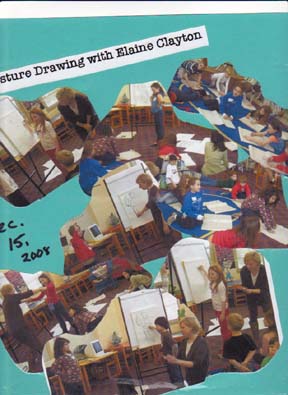
When I started using my method of gesture drawing as a way to encourage intuitive, empathic feeling and knowledge amongst school children, I had no trouble what-so-ever finding that original, powerful urge in each child to make marks. I have used this technique with pre-school aged children all the way through college age young adults, and every time, there is a beautiful and empowering result: each individual, with a little support and acknowledgement while making marks on paper, finds that something "other" is going on when drawing, especially if it is to draw another human being. I believe that sense of other is the complete and total, unconditional acceptance of self in relation to the rest of humanity (or at least to the others in the environment). This is arrived at with simple ground rules to establish freedom of expression, with heart and mind open as to the very important awareness of how others feel, and with mutual consideration and respect.
It seems to be a relief for everyone to try this different kind of exercise in school, I suppose because school days for the most part are set up to determine "winners" from "losers" and marks are made to represent the value of the winner, or to expose the failings of the loser. Therefore, classroom time dedicated to abolishing the notion that some of us are winners and others losers, some are more worthy than others, is welcomed from the heart by most. Changing the perception of what value and worthiness is, combined with the act of drawing, seems to unlock that natural-born desire to exist harmoniously and express, to be loved and love as well. People of all ages seem to recognize that this opens the heart and mind to receive empathic, intuitive intelligence. Without intentionally creating situations which reinforce the importance of empathy and intuitive expression, empathy and intuitive knowing is rarified and atrophied (and in some cases becomes an act of courage, an out of the ordinary response).
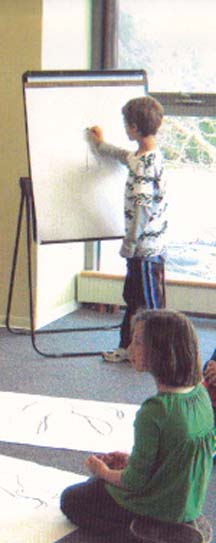
An easel with a large pad of newsprint is the center focal point of the room. The person at the easel is to stand comfortably, with the full support of the group, holding a soft piece of vine charcoal. The charcoal is easy to wipe away--these marks are about the process and the feeling behind the mark, rather than about the actual mark itself. The group is asked to imagine how it would feel to be exposed, up there in front of everyone, at the easel, daring to draw, risking injury and self-esteem. Those in the group observing are not to laugh or make fun of the drawing, only to enjoy it and encourage the mark maker, no matter how the drawing comes out. The exercise is not about creating a drawing that looks like the person posing, rather it is to represent the emotional, intuitive intelligence of the mark maker at the easel.
The mark maker is to gaze upon a fellow human being (usually an eager student peer volunteer) and keep that gaze, with the intent to feel how it would be to be that person in that pose, and to try and draw a linear expression of it. Without looking at the paper, she begins to draw a contour of the subject, with large motions of the arm, free and loose. The one posing is usually in an emotive gesture of some kind, such as hunched over exhausted or reaching up in great surprise. The crowd of witnesses "whisper count" to 20 when the mark maker at the easel begins to draw.
The mark maker is encouraged to draw large and fast, rather than slow. If a person draws small and slow in this exercise, he/she will usually begin to have self-doubt and will take his/her eyes off the subject/poser and try to look at the paper to "correct" what is "wrong" about the drawing. When this happens, the empathic and intuitive process is frozen and fear reigns. The mark maker at the easel begins to stare at the paper and feel isolated from the group and not at all engaged with the poser or with self. In an effort to "draw correctly", small details such as tiny eye lashes and clothing attributes become the focus for "fixing" the drawing, and the mark maker begins to fuss with such details, losing the focus on the overall emotional gesture of the subject. The mark maker is encouraged away from those fears, and reminded that any mark made while gazing at the subject and not at the easel, in order to capture the feeling of that subject's gesture, is absolutely wonderful and good. With care and verbal, emotional support from the group, the mark maker is prompted to try to draw without self doubt creeping in; to experience acceptance of self before the group, while making marks based on how the poser feels in the pose, all the while not looking at the paper or line as it is being drawn out.
Since there is no correct way to draw in this intuitive exercise, only to make a mark with a contour line that expresses what the poser is expressing physically, there is no need to self-doubt. When the mark maker at the easel has self trust and feels support from the group, this person is able to truly empathize with the poser, and to create that contour linear expression with real energetic intent. Suddenly, making marks based on the respectful regard of another (poser) is translated into self-empowerment for the mark maker, and empathic appreciation of the poser. Those witnessing and counting (encouraging the drawer to not allow self doubt to creep in) feel the benefit of their generosity toward the mark maker, and long to have a chance at the easel, too. For the mark maker who has released self-judgment and has experienced being supported by the group while drawing based on his/her intuitive observation of the poser, this exercise becomes about self-empowerment and empathic intelligence.
Ideally, this exercise is repeated within this group until everyone has had a chance to be supported by the group while they, too dare to make marks based on their empathy toward the poser. Typically what happens is a few kids pose at once, to assure everyone gets a chance to pose as well as draw. In the best cases, the easel is not put away once the drawing workshop ends, but put up somewhere in the school, with plenty of newsprint and charcoal so that children can continue to draw after lunch or during recess and continue practicing this intuitive exercise. There has always been such spontaneous appreciation and excitement for this drawing experience, and I am sure that it is in part due to the message that not only are our feelings valued, and therefore important; so is the essence of the marks we make, especially those which represent our personal regard for other human beings. I think another reason why people respond enthusiastically is because we know we have empathic, intuitive intelligence and any experience in life which allows us to use this form of knowing, especially as members of a group, resonates as meaningful and gives us well-being.
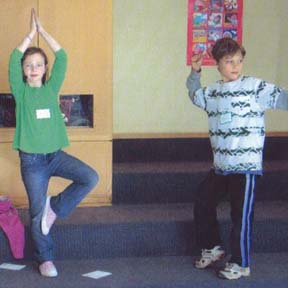
This drawing exercise is not new to artists, and is common in art studios where models are brought in to pose while artists practice "blind contours" also known as "gesture drawing"; drawing without looking at the paper, studying the model's gestures and releasing the potential to self-edit by continuing the linear flow of the charcoal on paper, with quickness in order to perfect the hand and brain connection. Once an artist has confidence and discipline, drawing slower is helpful to study more deeply the contour and volume of the model, to draw what is actually happening as opposed to what is easy to assume is happening. This is common, especially for figurative artists who translate intuitive intelligence into works of figurative expression by way of drawing, painting, sculpture. But this is not a common exercise in the school classrooms. What makes it exciting and meaningful to do in schools, in regular classrooms, is that it unlocks the original and innate, instinctive impulse in a child to express, and to intuit with compassion, the experiences of others. With that comes an open heart to begin to feel not just what someone experiences in their physical gesture, but what one feels on many levels, including the need to be accepted and valued by the group, as a unique individual within the group. This in turn creates a healthy learning environment, a humanistic, thoughtful and inclusive atmosphere in which intuitive intelligence is outwardly acknowledged.
The marks we make come from our internal response system as our senses work together to collect information and to react to that information. If we come to expect those marks we make to be used to only to determine our worth as "successful" or "unsuccessful" individuals, we are influenced to close down our empathy and intuition while we develop our skills. We are scared into competing with others in the great race to prove we are capable of success, and to rank one another accordingly. How different it is when we also make marks to prove the intrinsic worth of others, all the while embodying self-trust and compassion?
Drawing out intuitive intelligence is not difficult, simply because it is our nature to intuit, and to enjoy the thrill of making marks based on what we feel is our birthright. Without having to even think about it, we intuit and respond to our environment, and the marks we make say we're alive, we think, we feel and we are unique. There is no way to truly destroy this intuitive wellspring of potential within each of us, but for some reason, our society can do a pretty good job stunting it. Drawing to draw out intuitive intelligence is for me, the core of my life as an artist and teacher, as an intuitive reader and healer. We're all creators and healers in our own right, and I believe it starts with those first marks made.
*Elaine Clayton
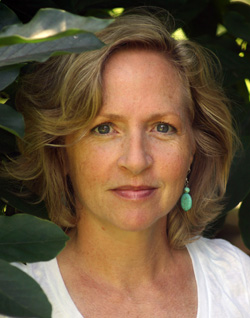
Elayne Clayton is the author and illustrator of several books for children and a former teacher. She is an intuitive reader and Reiki Master. Her new book, ILLUMINARA INTUITVE JOURNAL (WITH CARDS) will be out in spring 2011. Her website is http://www.illuminara.com/